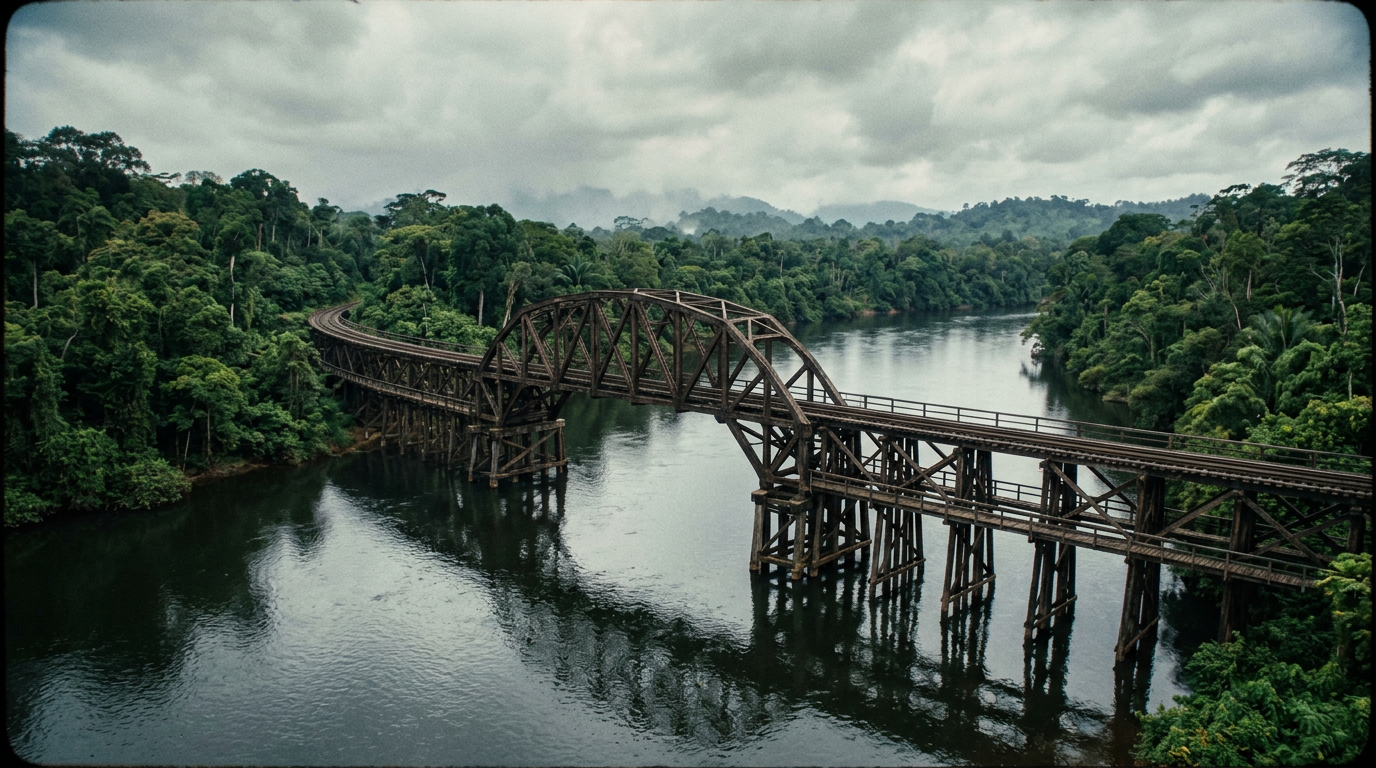
Original interpretation — not a still from the production
A British prisoner of war in Japanese captivity finds himself meticulously overseeing the construction of a bridge for his captors, blurring the lines between duty, pride, and collaboration.
The Continental Verdict
Essential
David Lean's monumental 1957 epic, *The Bridge on the River Kwai*, delves into the peculiar psychological landscape of Colonel Nicholson, a British officer whose unwavering adherence to military regulations extends even to his captors. Imprisoned by the Japanese in a Burmese POW camp, Nicholson, played with formidable conviction by Alec Guinness, insists on his men building a strategic railway bridge to precise British engineering standards. This dedication, ostensibly a morale-boosting exercise and a defiant act of professional excellence, slowly morphs into an obsession, overshadowing the larger strategic realities of the war. Lean's masterful direction, capturing the sweltering jungle and the arduous labour with vivid clarity, elevates a simple narrative of construction into a profound study of character and the peculiar nature of military honour.
Yet, the film is not merely a character study; it is a grand adventure and a biting commentary on the absurdities of war. William Holden’s Shears, an American escapee forced back into the conflict, provides a cynical counterpoint to Nicholson's rigid idealism, highlighting the futility and irony of their circumstances. As the bridge nears completion, a parallel plot unfolds involving a British commando team, led by Major Warden (Jack Hawkins), tasked with its demolition. The impending clash between Nicholson's unwitting pride in his creation and the Allied objective to destroy it builds to a harrowing crescendo, leaving the viewer to ponder the true cost of principle when detached from purpose. It is a work that remains as thought-provoking today as it was over six decades ago, a testament to Lean's enduring cinematic vision.
Why Watch It
The Gentleman Factor
The gentleman observes the dangers of principle divorced from pragmatism, the peculiar pride found in exacting craftsmanship even for an enemy, and the ultimate cost of unwavering conviction.
Look Out For
- Sweat-soaked khaki uniforms
- Tropical heat haze
- Precise military bearing
The Locations
The film was largely shot on location in Ceylon (modern-day Sri Lanka), with significant scenes filmed near Kitulgala on the Kelani River, doubling for the River Kwai in Burma. The iconic bridge itself was constructed for the film.
More from the travel pages →The Cars
While not a car-centric film, period military vehicles, predominantly jeeps and trucks, are visible in background scenes, befitting the 1943 setting.
More from motoring →The Wardrobe
Costume designer John Wilson ensured the uniforms, both Allied and Japanese, accurately reflected the period and the harsh jungle conditions. The meticulous attention to detail in the worn, stained, and often tattered attire underscores the realities of captivity and arduous labour.
More on style →The Soundtrack
Malcolm Arnold's Academy Award-winning score is unforgettable, particularly the iconic "Colonel Bogey March" whistled by the British POWs, a defiant and jaunty counterpoint to their grim circumstances.
Into the music room →Watch Next
Where to Watch
Available for streaming on various platforms and on Blu-ray/DVD. Regularly broadcast on classic film channels.
For the Collection
Also in War & History
As an Amazon Associate I earn from qualifying purchases. Links cost you nothing and never influence what we recommend. Recommendations are honest and never paid for. Imagery is an original interpretation, not a still from the production.