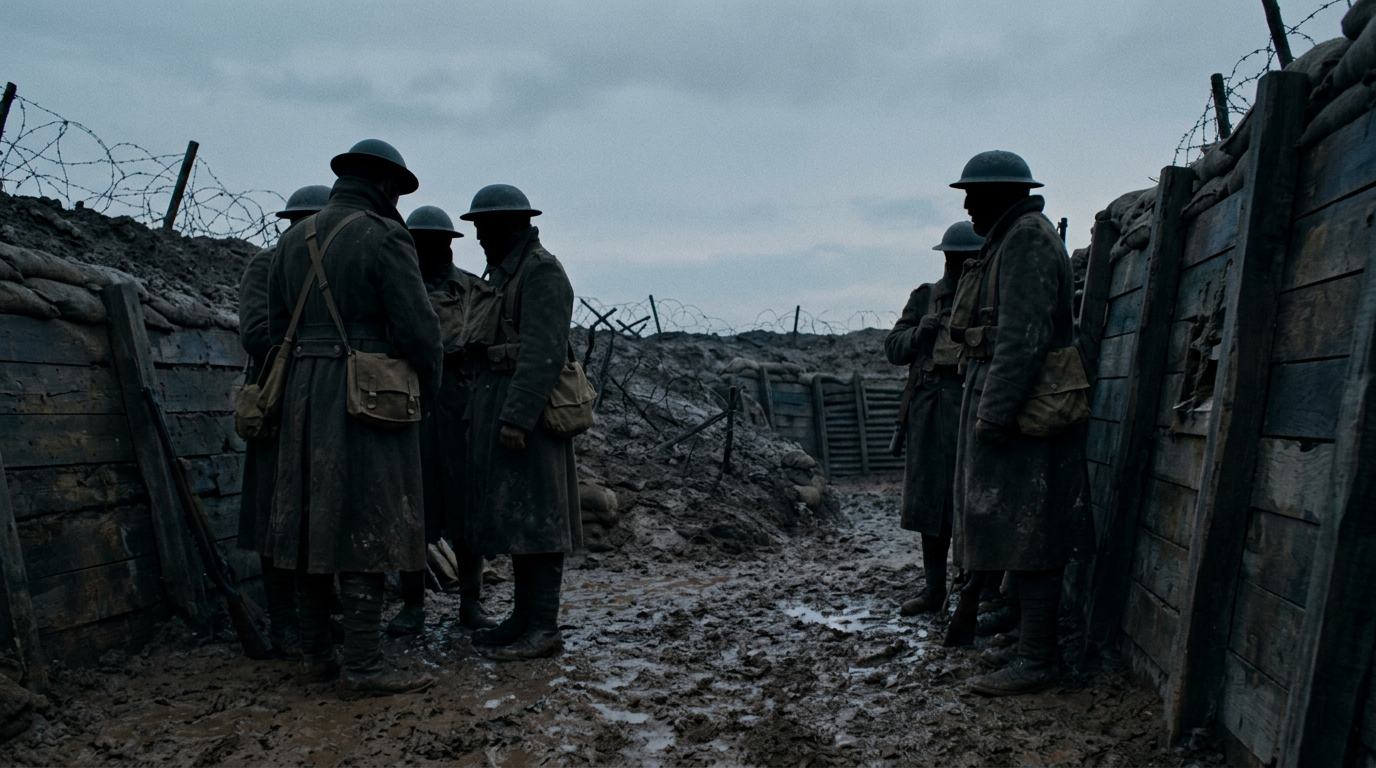
Original interpretation — not a still from the production
Stanley Kubrick’s searing critique of military hubris and the futility of war.
The Continental Verdict
Essential
Stanley Kubrick's 1957 masterpiece, 'Paths of Glory', remains a stark and unsettling examination of military injustice and the tragic absurdity of war. Set during the First World War, the film meticulously dissects the moral chasm between the command structure and the common soldier, presenting a narrative that is as relevant today as it was over sixty years ago. Kirk Douglas, in a career-defining role as Colonel Dax, delivers a performance of remarkable intensity and conviction, embodying the solitary voice of reason against an unforgiving system. His impassioned defence of three French soldiers, arbitrarily chosen for execution to serve as a 'lesson' to the troops, forms the heart of this poignant drama.
The film’s unflinching portrayal of trench warfare, the brutal realities faced by the infantry, and the arbitrary power wielded by distant generals, is both chilling and deeply humane. Kubrick’s signature long tracking shots through the trenches immerse the viewer in the claustrophobic dread of the front line, while the stark cinematography accentuates the bleakness of the circumstances. Far from a mere historical recounting, 'Paths of Glory' is a profound meditation on courage, cowardice, and the cost of human dignity in the face of institutional cruelty. It is a work that challenges the romanticisation of conflict, presenting instead a grim, unvarnished truth that resonates long after the final frame.
Why Watch It
The Gentleman Factor
To stand for principle, even when the odds are insurmountable.
Look Out For
- Black and white cinematography
- Expressionistic lighting
- Meticulous period detail
The Locations
Bavaria, Germany (principally Geiselgasteig Studios and Schleissheim Palace in Munich)
More from the travel pages →The Cars
None.
More from motoring →The Wardrobe
Georges Jacon, a masterclass in realistic, worn military attire.
More on style →The Soundtrack
Gerald Fried’s score, sparsely used, underscores the emotional gravitas without undue sentimentality. The final, poignant folk song, "The Faithful Hussar," sung by Christiane Harlan, is indelible.
Into the music room →Watch Next
Where to Watch
Available on Criterion Collection Blu-ray/DVD; streaming via Mubi and other platforms.
For the Collection
Also in War & History
As an Amazon Associate I earn from qualifying purchases. Links cost you nothing and never influence what we recommend. Recommendations are honest and never paid for. Imagery is an original interpretation, not a still from the production.