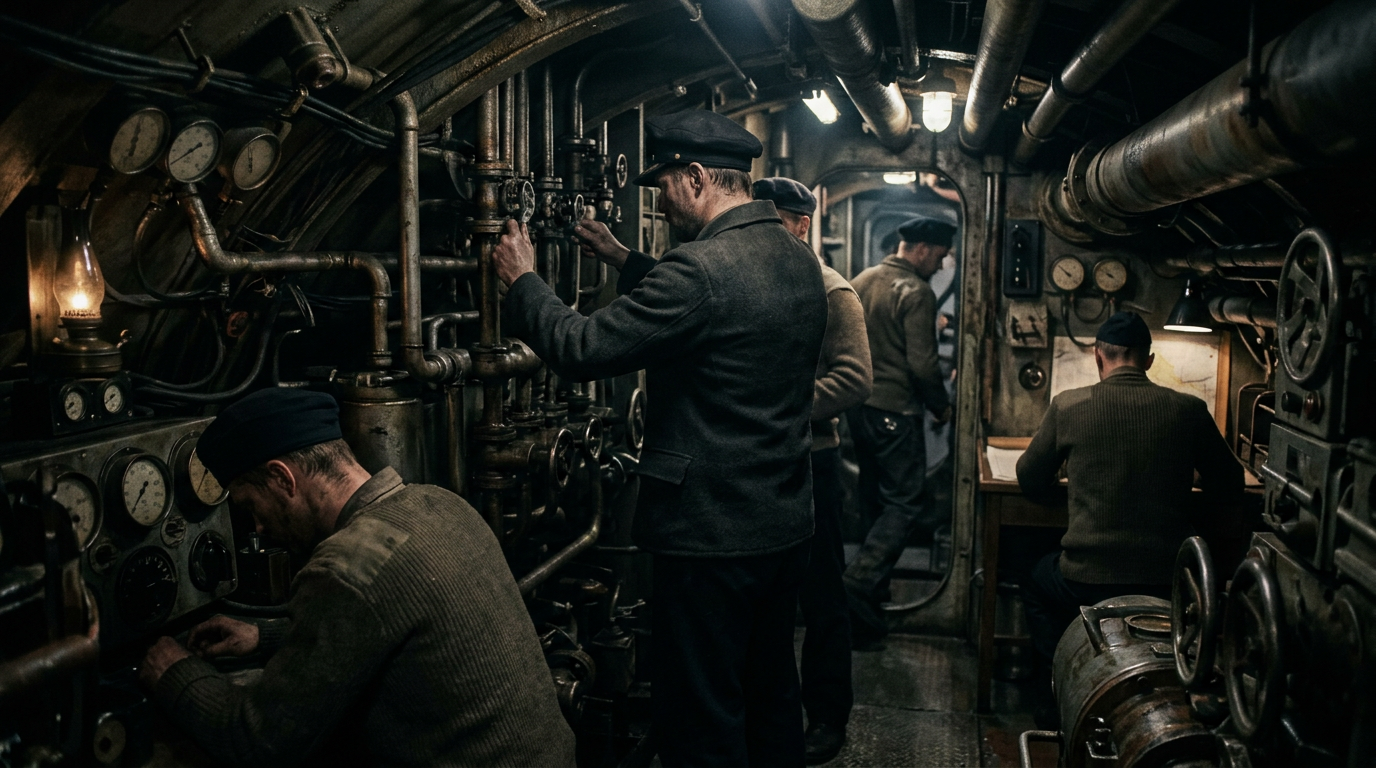
Original interpretation — not a still from the production
Wolfgang Petersen's harrowing portrait of life aboard a U-boat, "Das Boot," remains a masterclass in tension and claustrophobia. The Director's Cut, in particular, offers an even more immersive and unsettling experience.
The Continental Verdict
Essential
Wolfgang Petersen's 1981 epic "Das Boot" is not merely a war film; it is a profound study of human endurance, professional competence, and the psychological toll of prolonged confinement. Following the crew of U-96 during the Battle of the Atlantic, Petersen masterfully crafts a narrative that eschews jingoism in favour of grim realism. The film's brilliance lies in its meticulous attention to detail, from the cramped, oil-streaked confines of the submarine to the subtle shifts in the crew's morale as they navigate relentless depth charges, equipment failures, and the crushing weight of their impossible mission. Jürgen Prochnow's portrayal of the Old Man, the U-boat captain, is a career-defining performance – a figure of quiet authority, weary pragmatism, and profound humanity, whose leadership holds the fragile ecosystem of the submarine together.
What sets "Das Boot" apart, particularly in its extended Director's Cut, is its immersive quality. The audience is not simply observing the crew; they are sealed in with them, experiencing the bone-jarring concussions of explosions, the suffocating heat, and the chilling silence of the deep. It is a film that demands patience but rewards it with an unparalleled sense of dread and intimacy. Klaus Doldinger's iconic score, with its haunting main theme, perfectly complements the film's atmosphere, oscillating between moments of heroic defiance and mournful resignation. The narrative offers a stark, unflinching look at the realities of naval warfare, devoid of romanticisation, making it a pivotal work in the war genre and a testament to the resilience of the human spirit under extreme duress.
Why Watch It
The Gentleman Factor
The ability to maintain composure and execute complex tasks with precision when surrounded by chaos and certain doom. The quiet authority of a leader who understands the weight of command.
Look Out For
- Submarine interiors designed for authenticity, capturing the claustrophobic and utilitarian reality of a U-boat. Naval uniforms, stained and worn, reflecting the hardships of extended patrols.
- The stark contrast between the industrial grit of the U-boat and the vast, indifferent expanse of the Atlantic.
- The nuanced expressions of men pushed to their limits, reflecting fear, defiance, and professional resolve.
The Locations
Primarily filmed on a replica U-boat (U-96) built for the film, and in the Bavaria Studios in Munich. Exterior shots of the ocean were integral to the narrative.
More from the travel pages →The Cars
No cars feature prominently in the film, which is set almost entirely at sea.
More from motoring →The Wardrobe
The wardrobe, meticulously overseen by Monica Sohm and Rolf Zehetbauer, consists of authentic German Kriegsmarine uniforms, period civilian clothing for the opening scenes, and practical gear suited for submarine life. The wear and tear on the garments reflect the harsh conditions endured by the crew.
More on style →The Soundtrack
Composed by Klaus Doldinger, the score is instantly recognisable for its driving, melancholic main theme. It masterfully uses synthesizers and traditional orchestration to create an atmosphere of tension, dread, and occasional triumph. The soundtrack is integral to the film's immersive quality.
Into the music room →Watch Next
Where to Watch
Available on Blu-ray and select streaming platforms. The Director's Cut is highly recommended.
For the Collection
Also in War & History
As an Amazon Associate I earn from qualifying purchases. Links cost you nothing and never influence what we recommend. Recommendations are honest and never paid for. Imagery is an original interpretation, not a still from the production.