The Quiet Leap: Reconsidering the Jumping Hour
In a world of sweeping seconds, the discreet charm of the jumping hour offers a different, more deliberate appreciation of time's passage. We look at the history and modern revival of this captivating complication.
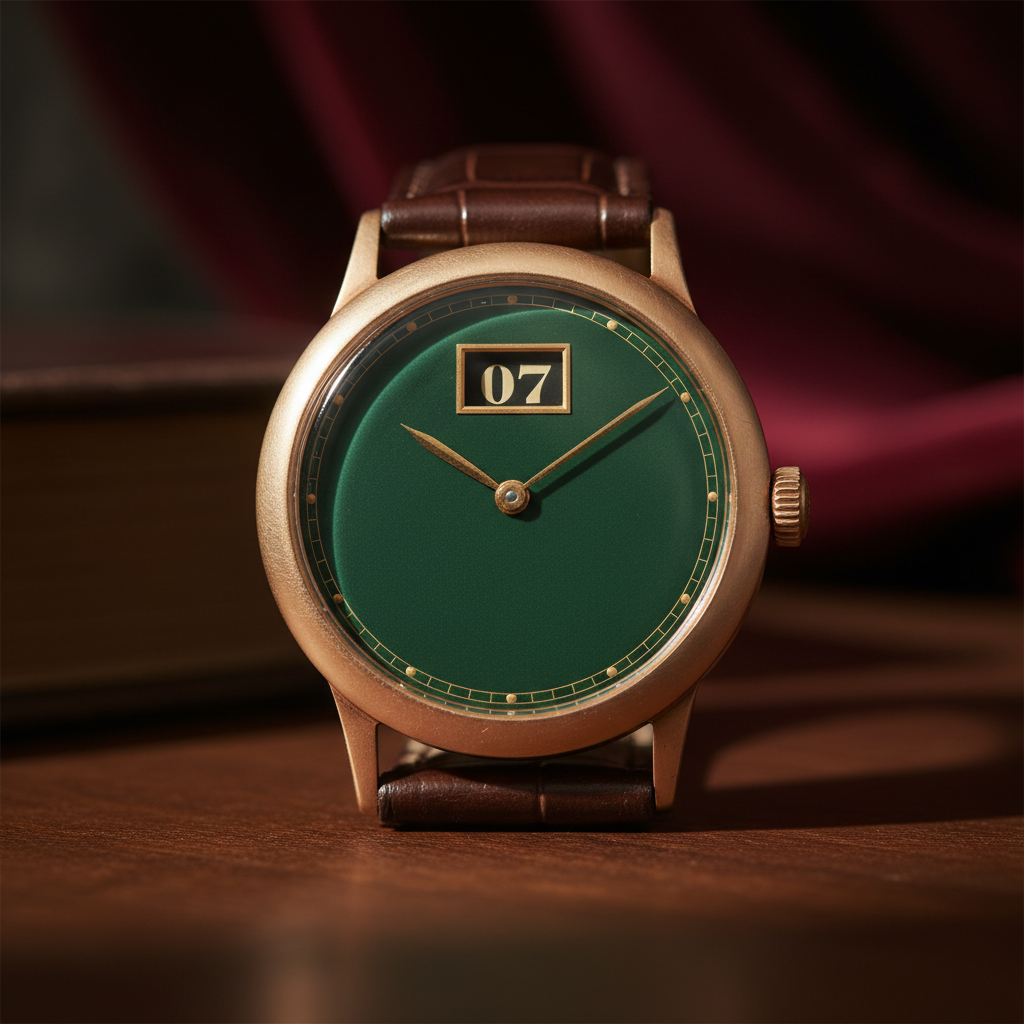
Time, in our mechanical companions, is most often a story told in arcs. The sweep of a seconds hand, the stately progression of the minute and hour. It is a constant, fluid motion, an analogue to our own perceived experience of its passage. Yet, there exists a complication that eschews this graceful dance for a more punctuated, decisive declaration of the moment: the jumping hour. It is a horological quiet protest against the perpetual sweep, a complication for the man who understands that some moments are more significant than others.
The jumping hour, or heure sautante, presents time digitally, typically through an aperture in the dial that displays the current hour as a numeral. On the sixtieth minute of every hour, this numeral ‘jumps’ instantaneously to the next. The minute hand continues its traditional sweep, but the hour is held in reserve, waiting for its precise moment of revelation. There is a certain theatre to it, a build-up of tension released in a single, satisfying click. It is a complication that demands patience and rewards it with a moment of mechanical precision.
The Digital’s Analogue Ancestry
One might be forgiven for thinking of the digital display as a child of the quartz revolution, yet its roots in mechanical watchmaking run surprisingly deep. The concept first appeared in the late 18th century, but it was in the 1880s that the first jumping-hour pocket watches were created to some commercial success by the Austrian watchmaker Josef Pallweber. These pieces, with their stark numerical displays, were a radical departure from the ornate dials of the era. IWC, among other houses, licensed the Pallweber patent, creating timepieces that remain startlingly modern to this day.
It was the Art Deco period, however, that provided the true crucible for the jumping hour. The era’s fascination with geometry, clean lines, and novel forms of expression found a perfect horological match in this complication. Wristwatches, still a relatively new concept, were fertile ground for experimentation. The digital display, often paired with wandering minutes or other unconventional indications, allowed for case shapes and dial designs that broke entirely with the round pocket watch tradition. These were not merely time-telling instruments; they were statements of avant-garde taste, worn by men who were shaping a new, modern world. And then, as with so many things, it faded. The clean, rational aesthetic of the mid-century and the later dominance of the quartz watch pushed this charming complication to the horological hinterlands.
A Modern Renaissance
For a complication to be truly great, it must be more than a historical curiosity; it must present a compelling challenge to the contemporary watchmaker. The jumping hour, in its modern incarnation, does precisely that. The instantaneous jump of the hour disc requires a significant and sudden release of energy, which must be carefully managed so as not to disrupt the delicate regulation of the escapement. Storing this energy over the course of sixty minutes and releasing it in a fraction of a second is a test of a movement's design and finishing.
It is little surprise, then, that the complication has been embraced by some of the finest independent and established manufactures of our time. A. Lange & Söhne’s Zeitwerk, for instance, is a Teutonic masterpiece of engineering, its large, clear digital display a bold declaration of technical prowess. The force required to jump not just the hours but also the minutes is immense, necessitating a remontoir d'égalité to ensure constant force is delivered to the balance. In a different, yet equally compelling vein, F.P. Journe’s Vagabondage series uses the jumping hour within a tortue case, a nod to the wandering forms of the pre-war era, while housing a thoroughly modern and inventive calibre.
To wear a jumping hour is to have a different relationship with time. It is to appreciate the quiet accumulation of moments that lead to a significant change. In a world of constant information, the jumping hour offers a moment of clarity, a single piece of data delivered with precision and flair. It is a reminder that while time may be a continuum, it is the discrete, well-defined moments that often matter most. It is, in the end, a complication not for telling time, but for considering it.