MotoringThe Final Expression: Lancia's 'Verde York' Integrale
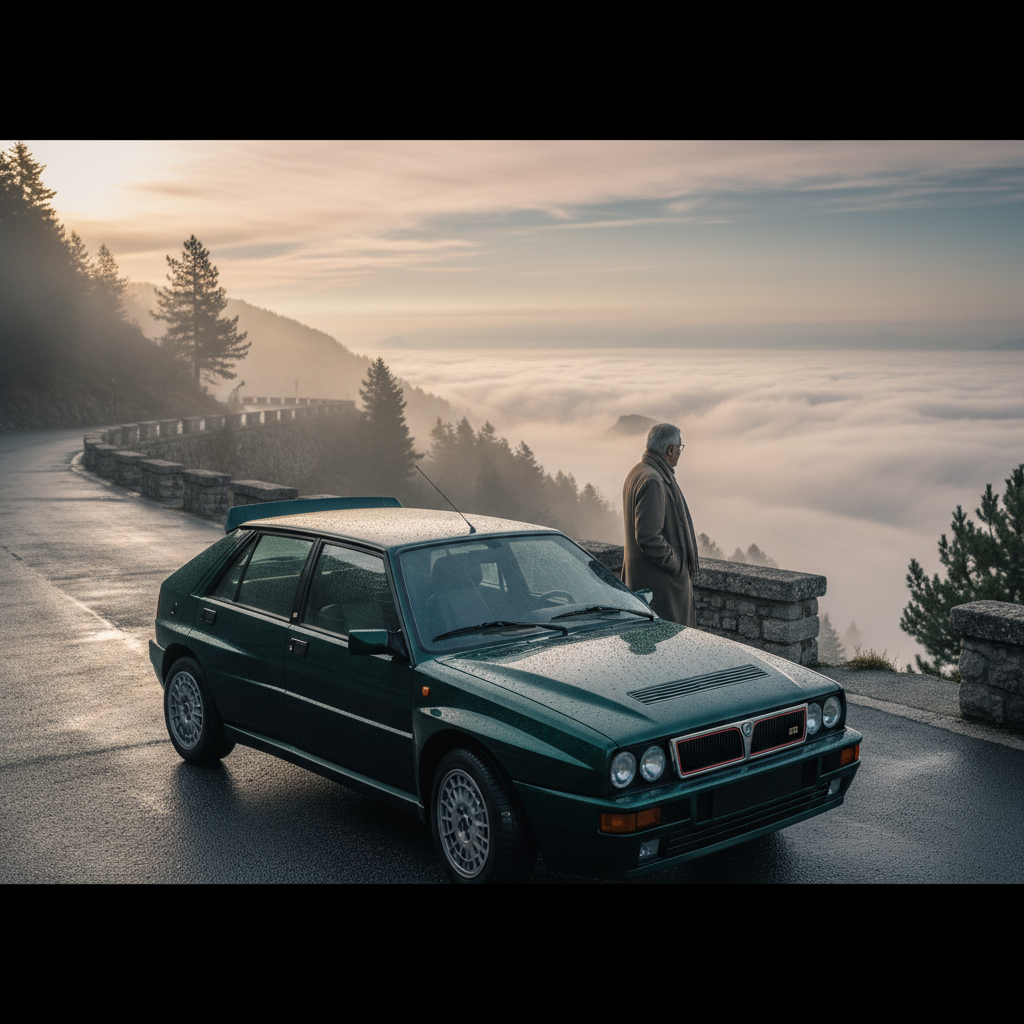
It was the last road-going version of a motorsport legend. We consider the Lancia Delta Integrale Evoluzione II in its most subtle and sought-after guise: the 'Verde York' collector's edition.
22 May 2026No. 0115 min read
'''There are certain machines that seem to carry the dust of the arena with them, even in their most civilized forms. They cannot entirely shed the grit and glory of their intended purpose. So it is with the Lancia Delta Integrale. To see one on a quiet street in Mayfair or parked in a reserved space in Gstaad is to witness a contradiction — a world champion rally car dressed, however reluctantly, in civilian clothes. Its pugnacious stance and blistered arches are a statement of intent, a memory of alpine hairpins and gravel stages, barely contained by the decorum of a license plate and traffic laws.
The Integrale was, from its inception, a homologation special. It existed to allow Lancia to go racing, and its evolution was dictated not by marketing focus groups, but by the relentless demands of the World Rally Championship. It was a tool for victory, first and foremost. That a road car of such character and capability emerged is a testament to an era of engineering that is unlikely to be repeated.
From Dust and Glory
To understand the genesis of the final Evoluzione II, one must recall the formidable shadow cast by its predecessors. After the dramatic demise of Group B rally, Lancia pivoted to Group A with an almost seamless dominance. The Delta HF 4WD and its subsequent Integrale iterations became the kings of the sport. The names are legend: Miki Biasion, Juha Kankkunen, Didier Auriol. They were the men who mastered these machines, wrestling them through the forests of Finland and the mountain passes of Corsica. With every victory, the legend of the road car grew. Lancia won the manufacturers’ championship six times in a row, a record that stands to this day. This was not a marketing exercise; it was total domination. The road-going Integrale was a direct beneficiary of this sporting development. The engine, the sophisticated all-wheel-drive system, the chassis — all were hardened and honed in the crucible of world-class competition. To buy an Integrale was to buy a piece of that heritage.
The Civilian Counterpart
The Evoluzione I of 1991 sharpened the package considerably, with a wider track and even more pronounced bodywork to accommodate it. But it is the Evoluzione II, launched in 1993, that represents the breed at its most refined. By this time, Lancia had officially retired from rallying, but the development of its road-going icon continued. The II featured an updated 16-valve turbo engine with a smaller, quicker-spooling Garrett turbocharger, producing a formidable 215 horsepower. More than the numbers, it was the way the power was delivered — a thrilling, analogue rush that demanded respect and attention from the driver. The cockpit, with its high-back Recaro seats trimmed in Alcantara or leather, was a place of business. The short-throw gear lever, the purposeful array of Veglia dials, the three-spoke Momo steering wheel — every element was designed for control. Driving an Evo II is an immersive experience. The steering is heavy but full of feel, the chassis communicates every nuance of the road surface, and the engine is a constant, breathing presence. It is a car that requires you to be a *driver*, not merely an operator.
A Coda in Green
Among the final run of the Evo II, certain special editions stand apart. But none are quite so desirable, nor so perfectly representative of the car