The Bernina Express: A Study in Civilized Passage
In an age of instant gratification, the Bernina Express offers a more refined proposition: a four-hour passage across the sublime theatre of the Alps, where the journey itself is the destination.
There is a particular quality to the light at high altitude, a crystalline sharpness that clarifies the mind and the landscape alike. To experience it from the hermetic quiet of a panoramic railway car, as the world unspools at a gracious pace, is to recall a mode of travel all but lost to the modern itinerary. We speak not of mere transportation, but of passage; a journey undertaken with the gravity and attention it deserves.
While the private jet has its place and the autostrada its grim efficiencies, the railway, particularly through challenging geography, remains a singular expression of human ingenuity and a vessel for a more contemplative form of travel. In this sphere, the Bernina Express, which stitches together the disparate climates of northern Italy and southeastern Switzerland, offers a compelling case for the enduring virtues of the slow road.
From Tirano to the Top of the World
The journey begins in Tirano, a town that feels more Italian than Swiss, nestled amongst vineyards and Renaissance palazzos. There is no great fanfare upon departure. The iconic red carriages of the Rhaetian Railway glide from the station with a quiet hum, beginning a steady, inexorable climb. What follows is not a brute conquest of the mountains, but a conversation with them.
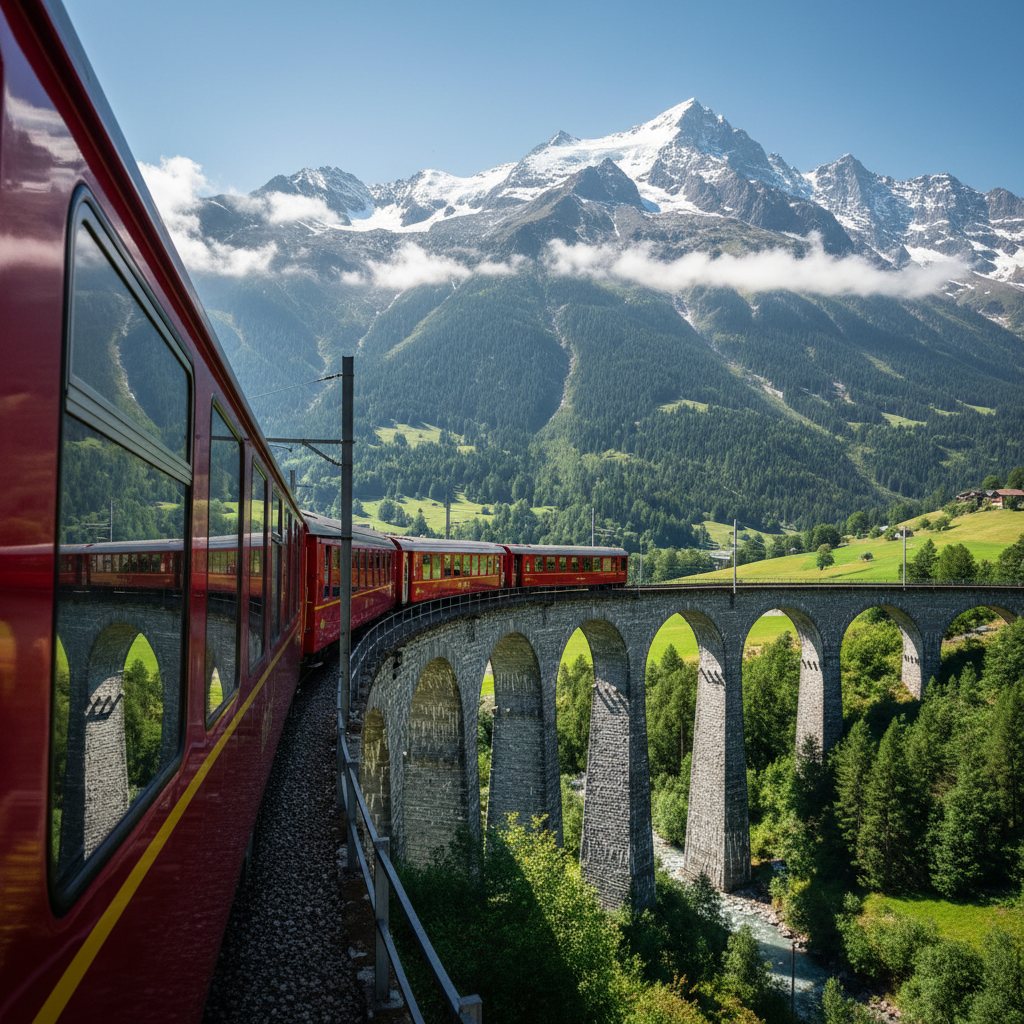
The line, a UNESCO World Heritage site, is a masterclass in elegant engineering. Rather than punch through the Alps with excessive tunneling, the railway engages in a delicate dance with the topography. It climbs gently, using nine viaducts and a series of helical tunnels to gain height almost imperceptibly. The most celebrated of these is the Brusio Circular Viaduct, an open-air spiral that allows the train to negotiate a steep gradient in a remarkably small space. It is a solution so graceful, so aesthetically pleasing, one might forget its purely practical considerations. As the train ascends, the landscape transforms. The last vestiges of the Italian lakes give way to larch forests, their needles a shock of gold in the autumn. Then come the firs, dusted with snow, and finally, the stark, magnificent world above the treeline.
The Theatre of the Engadine
Crossing the Bernina Pass at 2,253 meters, the train enters the Engadine valley, a high, dry plateau of frozen lakes and monumental peaks. This is the theatre of the journey. Through the panoramic windows, the Piz Bernina and the Morteratsch Glacier present themselves not as fleeting snapshots, but as grand, evolving compositions. The silence in the carriage is punctuated only by the faint click-clack of the rails and the occasional, respectful murmur of a fellow passenger.
There is a unique luxury in this enforced idleness. One is not a driver, burdened by the mechanics of the road, nor an airline passenger, divorced from the world below. One is simply an observer, a privileged spectator in a grand, natural diorama. The quality of light, the deep shadows carving the mountain faces, the impossible blue of a high-altitude sky—these are the details that emerge when time is allowed to expand. The journey encourages a different kind of seeing, a deeper appreciation for the sublime architecture of the natural world.
As the train begins its descent towards St. Moritz, that glittering jewel of the Alps, the feeling is not one of arrival, but of a gentle return to earth. The four-hour passage is a reminder that the purpose of a journey is not always to arrive. Sometimes, the most civilized act is simply to be in motion, to watch the world unfold from the quiet comfort of a window seat, and to appreciate the remarkable elegance of getting there. It is a lesson in the art of passage, written in steel rails across the roof of Europe.