The McLaren McL 6GT: A Manual Gearbox and a Long Memory
Woking has spent fifteen years being correct. At Monterey it finally did something interesting instead — and gave Bruce McLaren's unfinished road car a third pedal.
I have not seen the McLaren McL 6GT in person. Let us establish that at the outset, because I have spent the last two days looking at photographs of it the way one looks at a letter from someone who has finally, after years of silence, written back.
It was unveiled at Monterey on the fourteenth of August — a concept, or more honestly a pre-production prototype, with customer cars promised for 2028. That is a long way off. Long enough for a company to change its mind, change its owner, and change its designer twice over. McLaren has form in all three. But the thing that has been announced is so unlike anything Woking has shown me in fifteen years that I find myself doing something I had almost stopped doing about McLaren, which is paying attention.
The bit that matters, first
It has a manual gearbox.
Six speeds. An H-pattern. A clutch pedal — an actual third pedal, made of metal, requiring a left foot and a modest quantity of coordination. The first manual McLaren since the F1 in 1992, which means the first manual McLaren since the year I was still being told that mobile telephones would never catch on.
I want to sit with that for a moment, because it is genuinely strange. This is a company that built its modern identity on being the clever one. The engineering answer. The brand that would explain to you, patiently and at some length, why hydraulically cross-linked suspension was superior to anti-roll bars, why a carbon tub was non-negotiable, why the dual-clutch was simply faster and therefore simply better and therefore why would you want anything else. McLaren spent a decade and a half being correct.
And correct, it turns out, is not the same as beloved.
A long time being right
The 12C arrived in 2011 and was, by every measurable standard, superb. It was also, by every unmeasurable one, slightly cold. There followed the 650S, the 675LT, the 570S, the 720S — genuinely brilliant cars, all of them, and I will hear no argument that the 720S is anything other than one of the great supercars of the century. But somewhere in that alphabet soup of three-digit numbers and suffixes, McLaren developed the problem of the very gifted student: everybody admired it, nobody quite wanted to have dinner with it.
Then came the Speedtail and the Sabre and the Elva and the Solus and the various other MSO exercises, and by about 2022 I could no longer reliably tell you which McLaren was which without looking it up, which is not a thing you should ever be able to say about a supercar company. The design language had folded in on itself. Every car was a series of teardrops and hollowed-out flanks and floating buttresses, all of it aerodynamically justified and none of it memorable. Meanwhile Ferrari built the Monza, Porsche built the S/T, Aston built the Valour — cars that were unapologetically about feeling rather than lap time — and McLaren, the cleverest of the lot, watched from the pit wall.
Then Abu Dhabi bought it. CYVN completed the acquisition in 2025, folded in a British electric start-up called Forseven, installed Nick Collins as chief executive and Alister Whelan as chief creative officer, and everyone in the business assumed we were about to be shown a very fast, very silent crossover.
Instead they showed us a manual.
The car Bruce never finished
The name is not decorative. In 1969, Bruce McLaren took an M6 Can-Am chassis — the car that had comprehensively humiliated everything in North America — put a roof on it, and began developing a road car called the M6GT. He intended to build it in numbers, homologate it, and drive it himself. He did drive it himself, with the registration OBH 500H, and by all accounts terrorised the Surrey lanes in it.
He died at Goodwood in June 1970, testing the M8D. The M6GT died with him, at a total production run of three or four cars depending on who you ask and how generous you are being about what counts as a car.
So the McL 6GT is a fifty-six-year-old unfinished sentence, picked up mid-clause. That is either the most cynical piece of heritage marketing of the decade, or it is the single most legitimate thing McLaren has done since the F1. Having looked at the car, I am fairly confident it is the second, and here is why: they did not simply put a retro nose on a 750S. They went back to the actual shape.
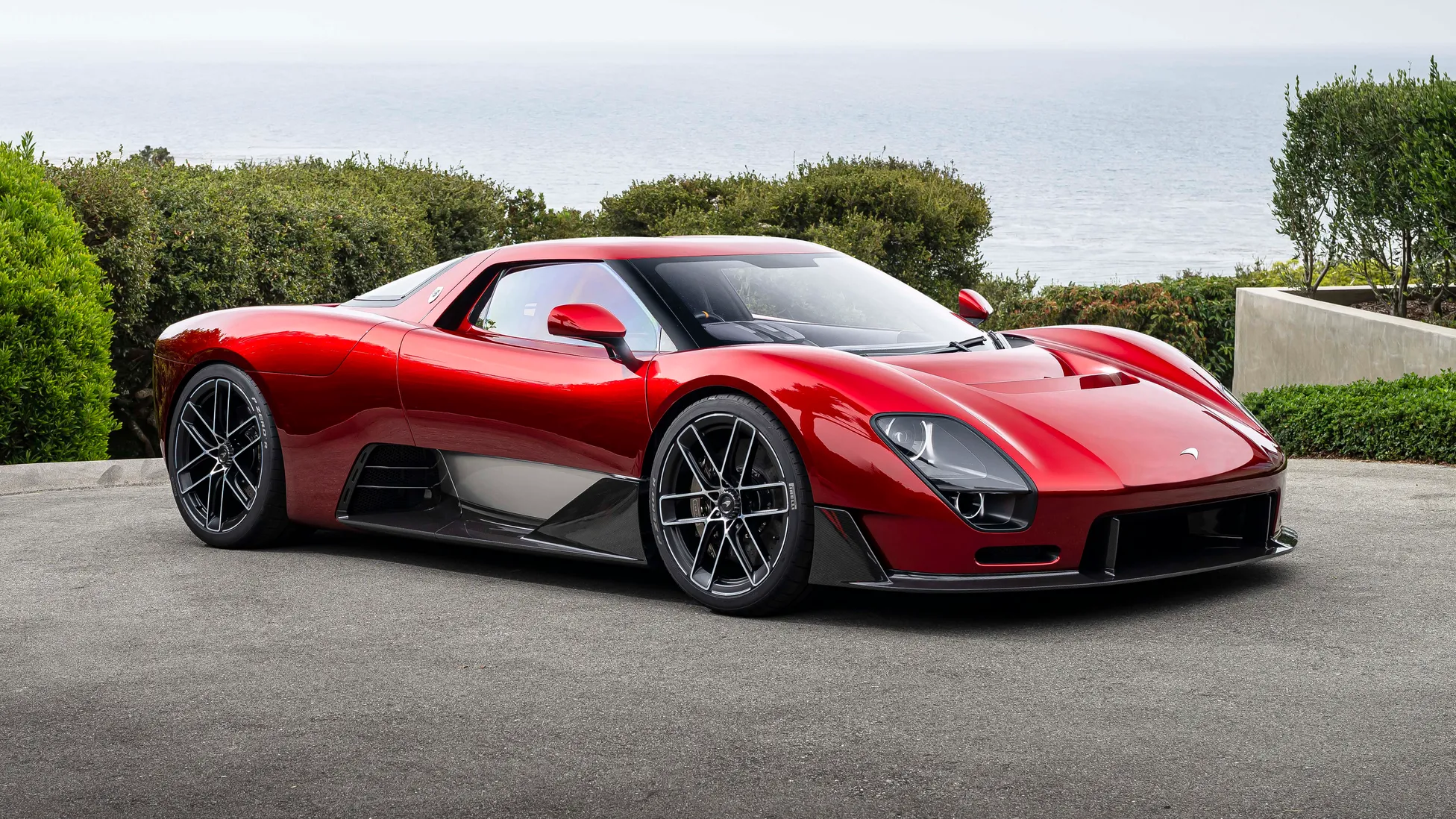
Look at it. That canopy — the wraparound glass, the roof that tapers to nothing, the way the greenhouse sits on the body like a bubble set into a stone rather than a windscreen bolted to a bonnet. That is the M6GT. That is also, if we are honest, a little bit of Ford GT40 and a little bit of Lola T70, because that is what everyone was doing in 1969 and everyone was doing it because it was right. The front is almost shockingly plain: two round headlights under a smooth clamshell, a lower splitter doing the actual aerodynamic work, and a nose that does not have a single unnecessary crease on it. There is no gaping intake shaped like a scream. There is no fussy vertical light signature designed to be recognisable in a wing mirror at two hundred miles an hour.
It is, and I do not use this word about modern supercars, pretty.
On the colour, briefly
They painted it red.
McLaren. Red. After fifteen years of Papaya-or-nothing, of volcanic-this and azores-that, of a brand identity so orange that I once watched a man at Salon Privé genuinely struggle to be photographed next to his own car in daylight — they have painted the halo concept a deep, wet, almost Barolo red, and photographed it against the Pacific with a hedge behind it.
I am not going to pretend this is engineering news. But it tells you something about the new regime's confidence that they were willing to walk into Monterey, on Ferrari's home weekend of the year in spiritual terms, wearing that colour. It is the automotive equivalent of turning up to a black-tie dinner in a midnight-blue dinner jacket. Everyone notices. Nobody can quite complain.
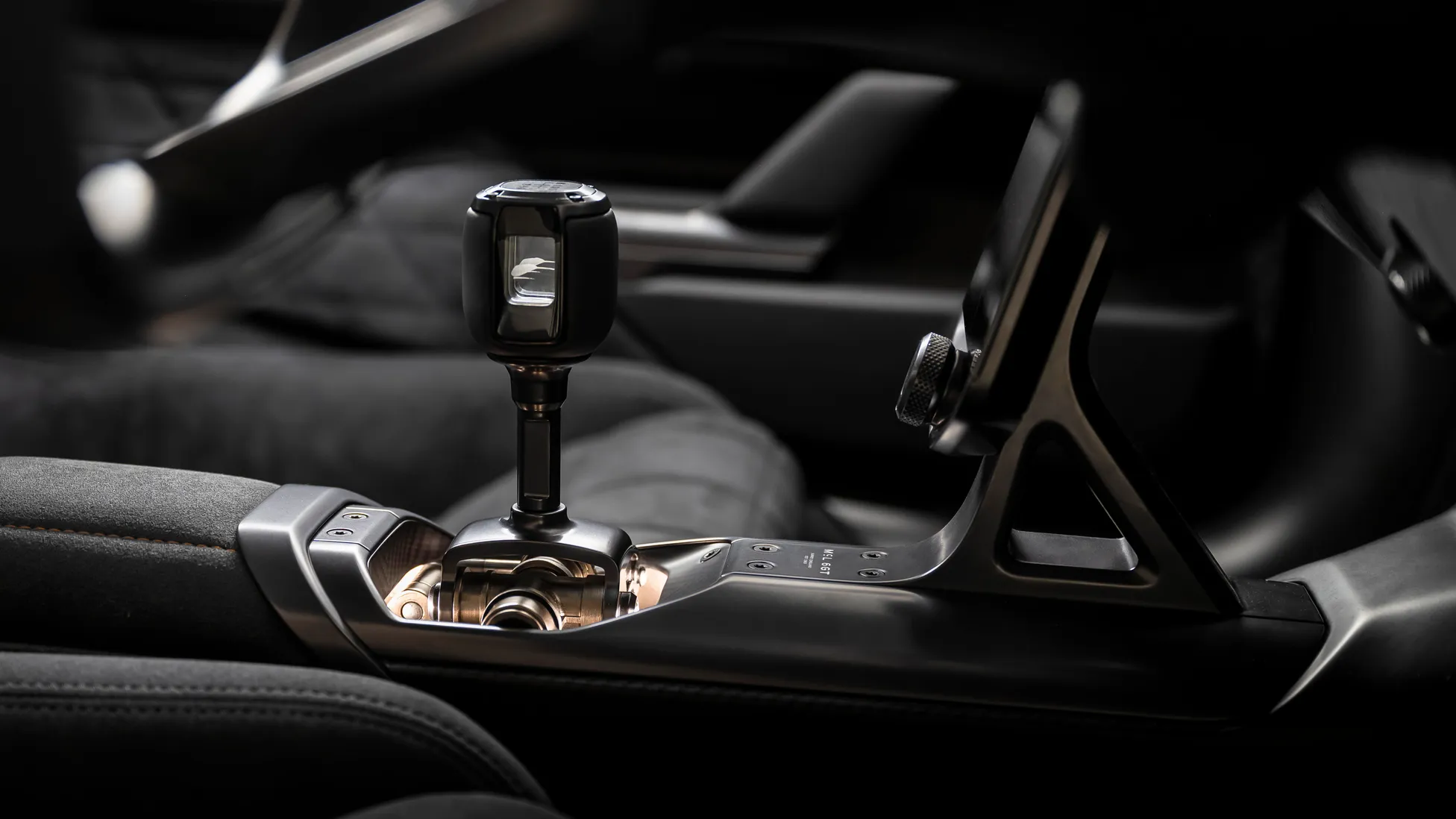
The gear lever is the whole argument
The interior photograph is the one that undid me. Not the seats, not the screen, not the trim — the shifter.
They have exposed the linkage. The gate mechanism sits in an open well in the centre console, machined from what appears to be brass or bronze, gleaming under the cabin lights like the escapement of a pocket watch with the caseback off. You can watch the mechanism work. You can watch your own gearchange happen.
There is no engineering reason for this. Covering it would be lighter, quieter, cleaner, cheaper and better sealed against the crumbs of a service-station sandwich. Exposing it is pure theatre — and it is the most emotionally intelligent decision McLaren has made in twenty years. It is the same instinct that makes a good watchmaker put a sapphire caseback on a movement nobody will ever see running. It says: this was made by people, and we would like you to know it.
Lamborghini used to do the open gate, of course, and abandoned it, and has spent the fifteen years since being asked why. Pagani still does it. Ferrari retired it and now sells the memory of it back to us at auction for eight figures. McLaren, who never had one, has just built the best one anybody has done.
The obvious objections
Yes, it is a concept. Yes, 2028 is two years away and concept interiors have a habit of becoming production interiors in the way that holiday photographs have a habit of becoming the actual holiday. Yes, the horsepower figure has not been confirmed, the price has not been confirmed, and the production run has not been confirmed, which in this end of the market usually means "more than you have and fewer than you would like."
And yes — a manual gearbox is slower. It is measurably, indisputably, stopwatch-provably slower than the dual-clutch McLaren already builds, and any owner who takes an McL 6GT to a track day will be beaten by a man in a used 720S with a nine-year-old set of Trofeos and a poor attitude.
I could not care less, and neither, I suspect, could you. We passed the point where supercars needed to be faster somewhere around 2015. What they need now is to be interesting to operate at legal speeds, because that is the only place most of them will ever be operated, and a car that requires something of its driver at fifty miles an hour on a wet Yorkshire B-road is worth six of a car that only comes alive at a hundred and forty on a runway.
What it actually signals
McLaren says the McL 6GT previews a new, more exclusive line sitting above and outside the core range. Read that carefully: not a replacement for the GT, not a variant, not another suffix. A separate shelf.
That is the right strategy, and it is the one Porsche has been printing money with for a decade. Build the sensible cars to pay the bills. Build the strange, deliberate, mechanically honest ones to remind everybody why the sensible cars are worth buying. The 911 exists so the S/T can exist; the S/T exists so the 911 means something.
If McLaren has finally worked that out — and if the new ownership has the patience to let a design chief build something that is pleasant to look at rather than merely justified by CFD — then the McL 6GT is not a nostalgia exercise. It is the first sentence of a second act.
A closing thought
I have not driven it. I have not sat in it. In 2028 I may discover that the clutch is too heavy, the pedal box is offset by an inch, the exposed linkage rattles over cobbles, and the whole thing is a very expensive lesson in why we invented the paddle.
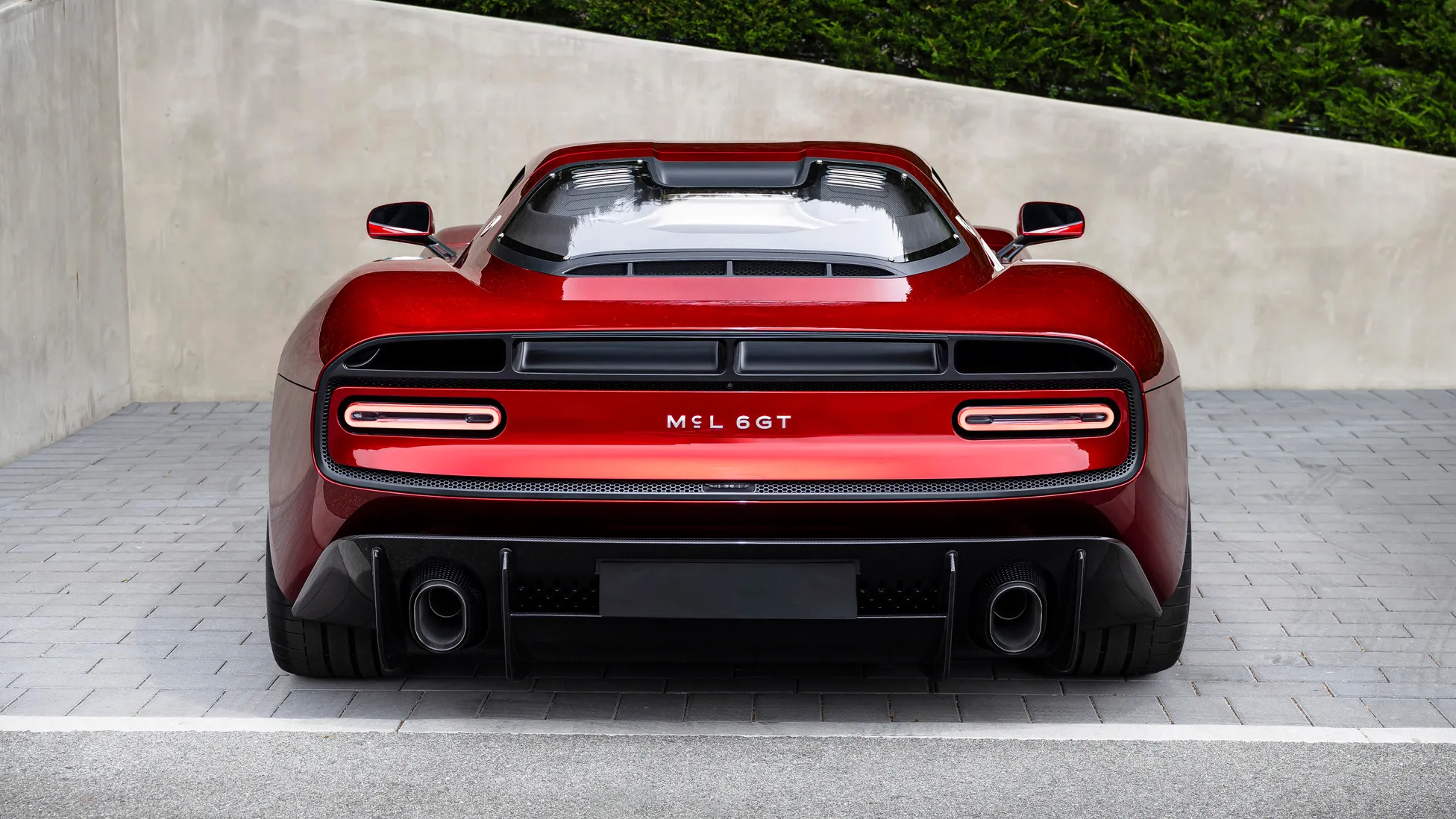
But there is a photograph in the press pack of the rear of the car — the wide, plain tail, the two round lamps, the mesh, and in the middle, in small unhurried lettering: McL 6GT. No badge the size of a dinner plate. No wing. No apology.
Bruce McLaren was thirty-two when he died. He had won at Le Mans, built his own Grand Prix car, and was in the middle of designing a road car he wanted to drive to work. Fifty-six years later, a company owned from Abu Dhabi and run by a man from Ford has looked at that unfinished object and decided, against every commercial instinct of the age, to finish it with three pedals.
That is not a product launch. That is a company remembering its own name.