Auberge du Pont de Collonges: The Citadel on the Saône
On the fog-bound banks of the Saône, Paul Bocuse’s legendary auberge remains an uncompromising, butter-rich cathedral to classical French technique.
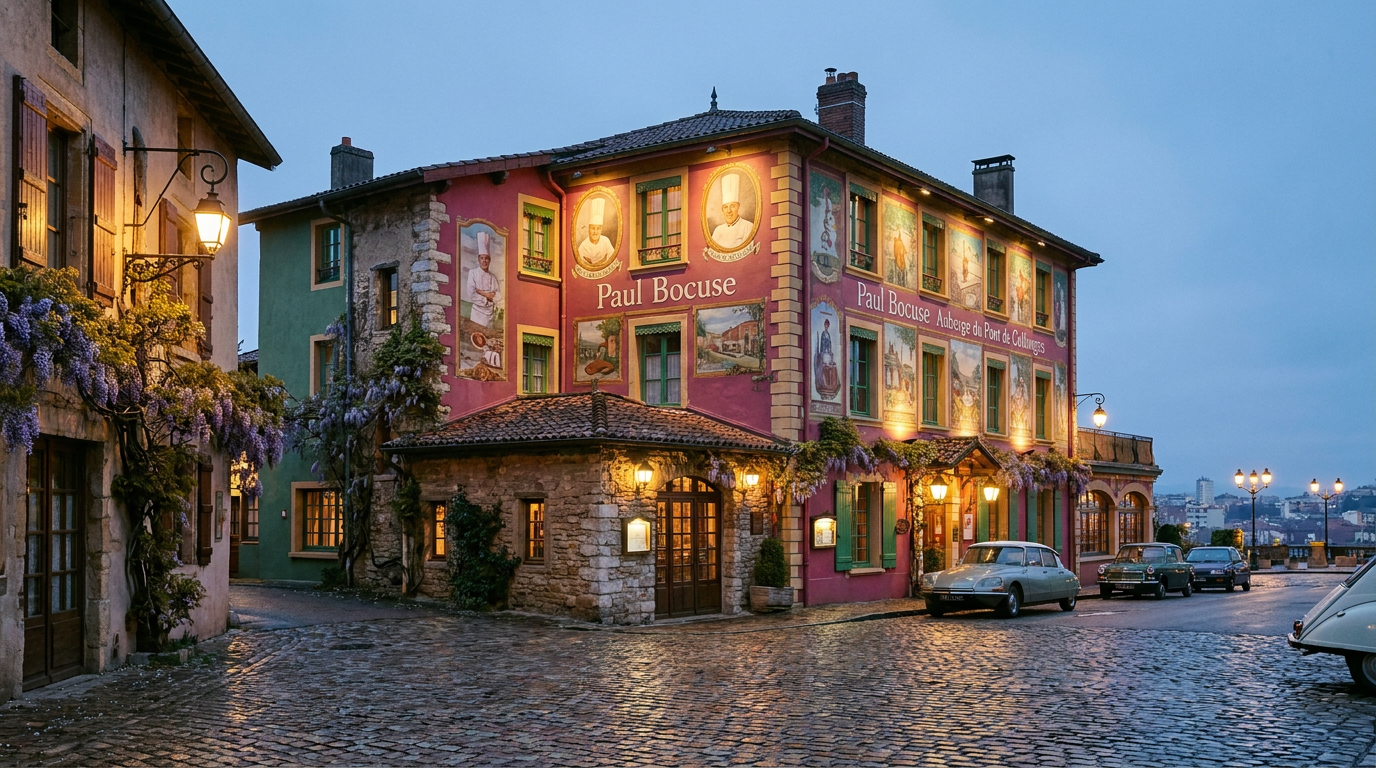
The November fog had settled low over the Saône as I crossed the Pont de Collonges, muting the poplars along the towpath into charcoal silhouettes. To arrive at Auberge du Pont de Collonges in the damp chill of late autumn is to be reminded that Paul Bocuse never traded in subtlety of facade. The exterior remains an unabashed canvas of raspberry pink and pistachio green, accented by trompe-l'œil murals depicting the pantheon of French culinary history—Carême, Escoffier, Fernand Point. In an era when high gastronomy has largely retreated behind minimalist Scandinavian pale oak or limestone monodic calm, Collonges still announces itself with the brassy, operatic confidence of 1965, the year it first secured three Michelin stars.
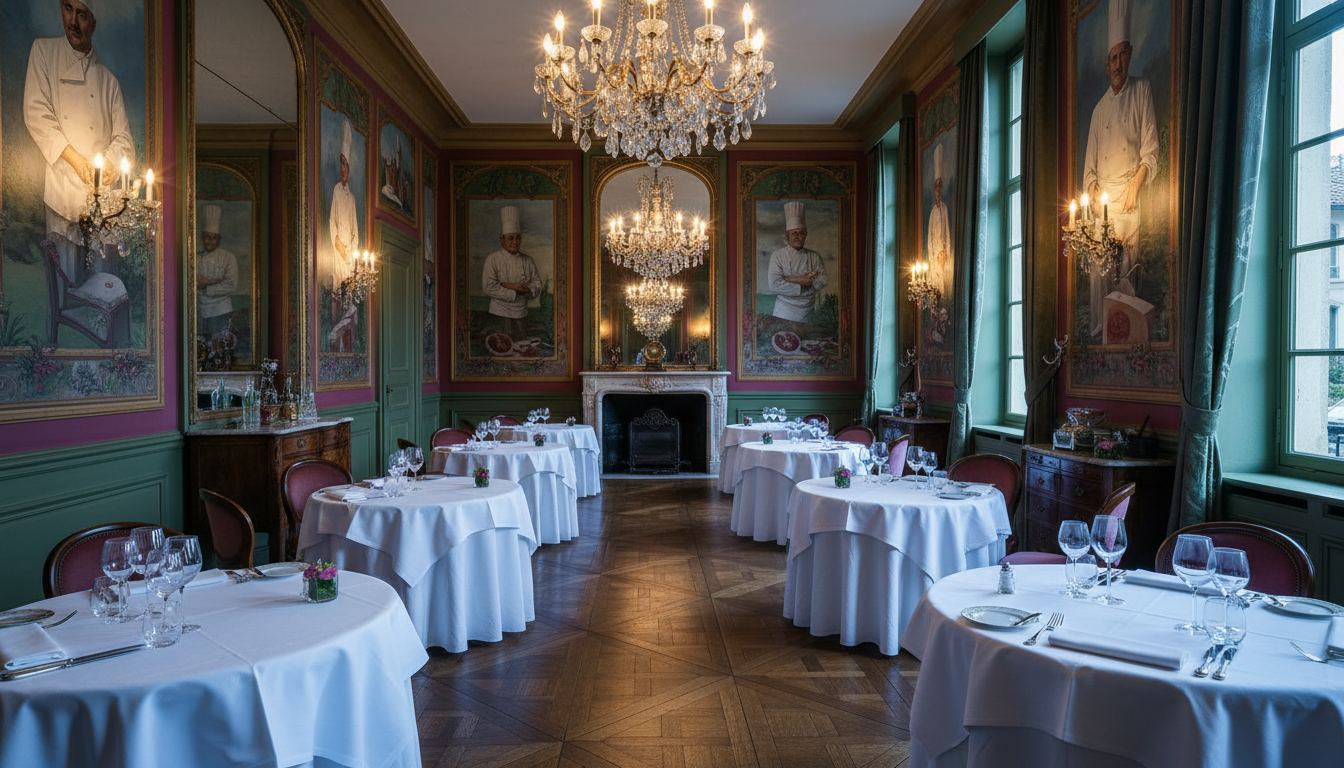
Step through the tall front doors, however, and the theatrics give way to the deepest, most comforting ritual in the Western dining tradition. The floor does not hum with anxiety; it glides. The maître d’hôtel greeted me with the serene gravitas of someone who understands that hospitality is an architecture, not an improvisation. My coat disappeared, and I was escorted into the central salon, where the parquet gleamed beneath heavy Flemish chandeliers, and the tables were dressed in starched damask so thick it could almost stand unsupported.
The Architecture of Succession
Much ink was spilled following Monsieur Paul’s passing in 2018, and still more when the red guide controversially rescinded the third star two years later. Yet sitting in the dining room on a brisk Tuesday evening, the chatter of purists and iconoclasts feels absurdly distant. The kitchen is now steered by a formidable triumvirate of Meilleurs Ouvriers de France—Gilles Reinhardt, Olivier Couvin, and pastry chef Benoît Charvet. Their mandate has not been to dismantle the temple, but to polish its keystones until they catch the modern light without losing their weight.
My dinner commenced with the cellar's counsel: a glass of 2017 Meursault from Domaine des Comtes Lafon, poured with that effortless, wrist-guided precision unique to Lyon’s grand brigades. It was cool, flinty, and possessed of enough fat to meet what lay ahead. The service here remains an unbroken choreography of guéridons. Silver domes are lifted in unison; carving knives are drawn across mahogany trolleys with the rhythmic rasp of fine steel against leather.
The arrival of the soupe aux truffes noires V.G.E. is, by now, an internationally recognized rite, yet familiarity does nothing to dull its impact. Created in 1975 for President Valéry Giscard d’Estaing at the Élysée Palace, it arrives as an inflated dome of burnished, buttery puff pastry, taut as a snare drum.
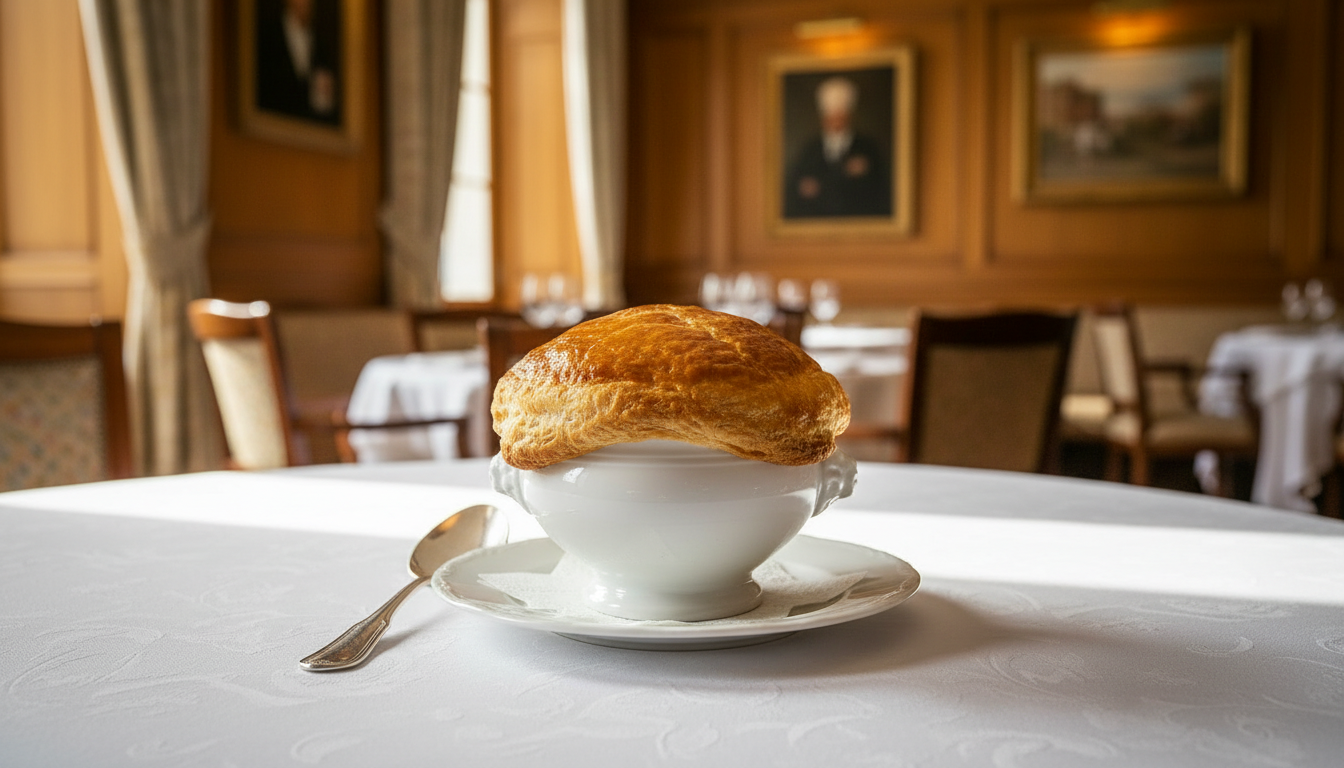
Breaking the crust with a silver spoon releases a plume of steam that transforms the immediate air into pure autumn woodland: white Port, double beef consommé, diced foie gras, and black Melanosporum truffles shaved with aristocratic abandon. The technique is flawless, but the emotion is primal. It is soup designed not to provoke an intellectual debate, but to warm the marrow of men who have spent the afternoon walking through damp vineyards.
Classicism Without Apology
The contemporary aversion to butter and cream finds no quarter here, nor should it. What Bocuse understood—and what his successors preserve with astonishing discipline—is that richness without precision is vulgarity, but richness harnessed to perfect acidity and rigorous reduction is transcendence.
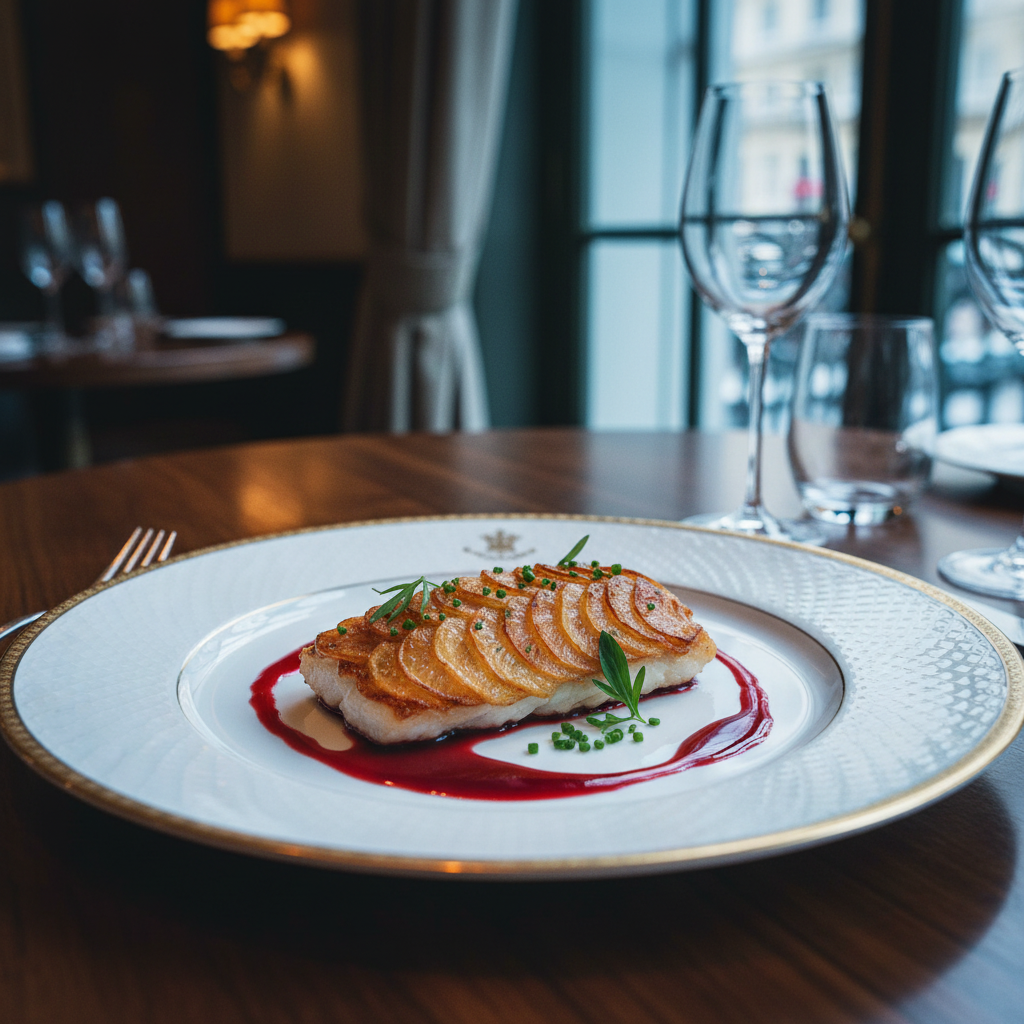
Consider the rouget barbet en écailles de pommes de terre. The red mullet, landed from Mediterranean day-boats, lay beneath a mosaic of paper-thin potato rounds crisped to a deep amber in clarified butter. The fish remained translucent at its core, while the pan sauce—a classic emulsified reduction enriched with orange zest and Noilly Prat—offered a clean, saline counterpoint that cut through the starchy crunch. It is a dish that leaves no margin for error; ten seconds too long under the salamander, and the mosaic curls or the flesh goes dry. It arrived immaculate.
Around me, the room hummed with a rare demographic harmony. At the adjacent banquette sat three generations of a Lyonnais silk dynasty, the grandfather methodically carving a Bresse hen; across the aisle, two young Tokyo chefs sat with notebooks open, their expressions poised somewhere between awe and analytical scrutiny. Collonges has never been an exclusionary salon for the self-conscious avant-garde. It remains a civic cathedral of French appetite, rooted in the peasant abundance of the Bresse plain and the bourgeois appetite of the Presqu'île.
The Ritual of the Gueridon
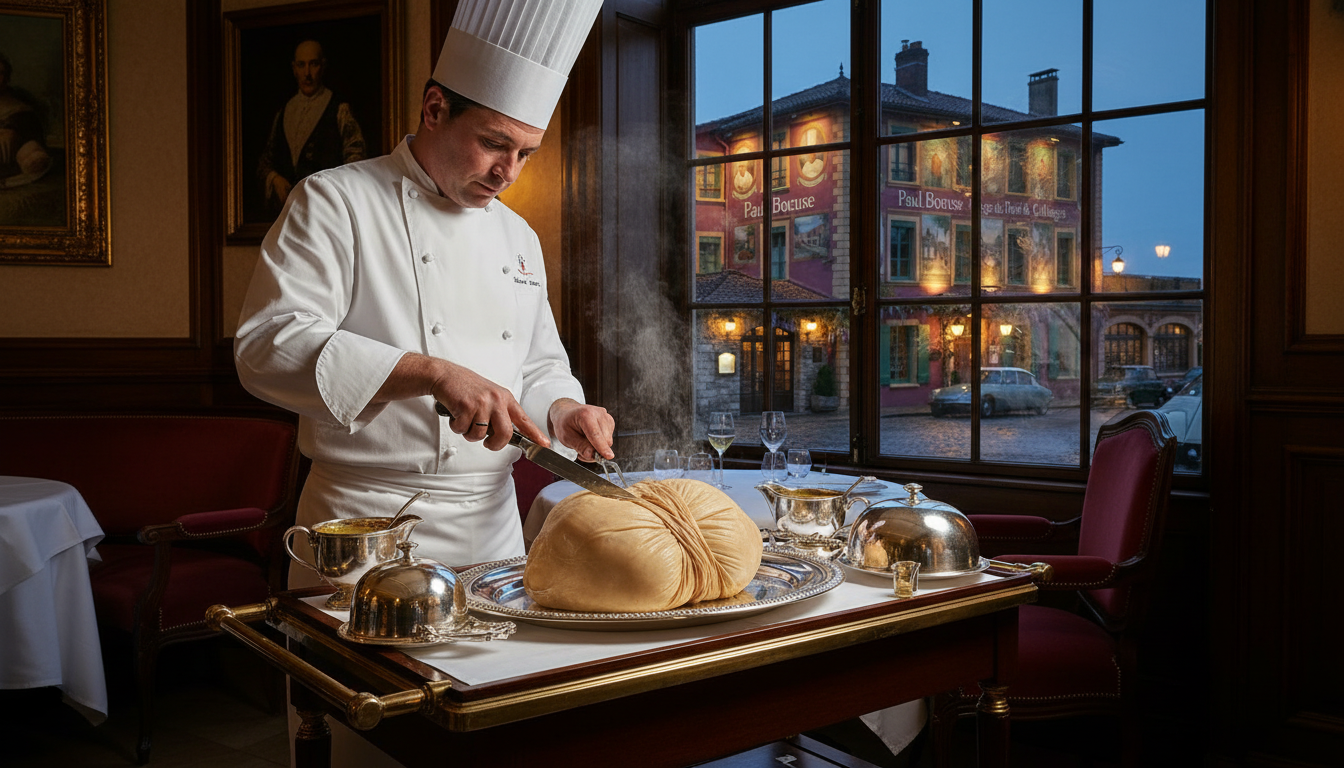
The centerpiece of the evening was the volaille de Bresse en vessie, prepared in the manner of Fernand Point, Bocuse’s mentor at La Pyramide. Brought to the tableside inside an inflated, taut pig’s bladder that bobbed gently in its poaching liquor like a pale parchment lantern, the dish represents the zenith of French charcuterie-adjacent technique.
The maître d’ pierced the bladder with deliberate ceremony, unleashing an intoxicating cloud of truffled steam that silenced the surrounding tables. With swift, practiced strokes of the carving blade, the breasts were lifted, revealing black truffles slipped beneath the skin like dark lace, and bathed in a sauce suprême that possessed the pale, glistening sheen of spun satin. Accompanied by buttered cardoons and wild morels, it was a masterclass in thermal conservation; cooked entirely within its own humid microclimate, the poultry had surrendered none of its juices to the pot.
A bottle of 2015 Côte-Rôtie from Guigal provided the necessary iron, pepper, and violet backbone. It was wine made within an hour's drive of where I sat, poured for food conceived within twenty paces. This geographic coherence is what the internationalized school of tweezers and foraging so frequently fails to grasp: genuine terroir is not simply what grows wild behind the kitchen, but the dialogue between a river valley, its livestock, and three centuries of saucecraft.
Before the dessert trolley appeared—laden with floating islands, Saint-Honoré, and praline tarts glowing like polished carnelian—I stepped for a moment into the corridor leading toward the kitchens. Through the wide glass panes, the brigade moved in silent, white-toqued harmony, copper pots reflecting the blue gas flames. The modern culinary landscape is restless, obsessed with the shock of the new and the fleeting tyranny of seasonal reinvention. Yet there on the banks of the Saône, as midnight approached and the fog thickened against the glass, Paul Bocuse’s kitchen stood resolute: an unassailable bastion of classical proportion, reminding us that some truths do not require revision.