F.P. Journe's Chronomètre à Résonance: A Duet in Time
A reflection on the elusive physical phenomenon of resonance, and how one of modern watchmaking's masters harnessed it to create a timepiece of singular precision and intellectual beauty.
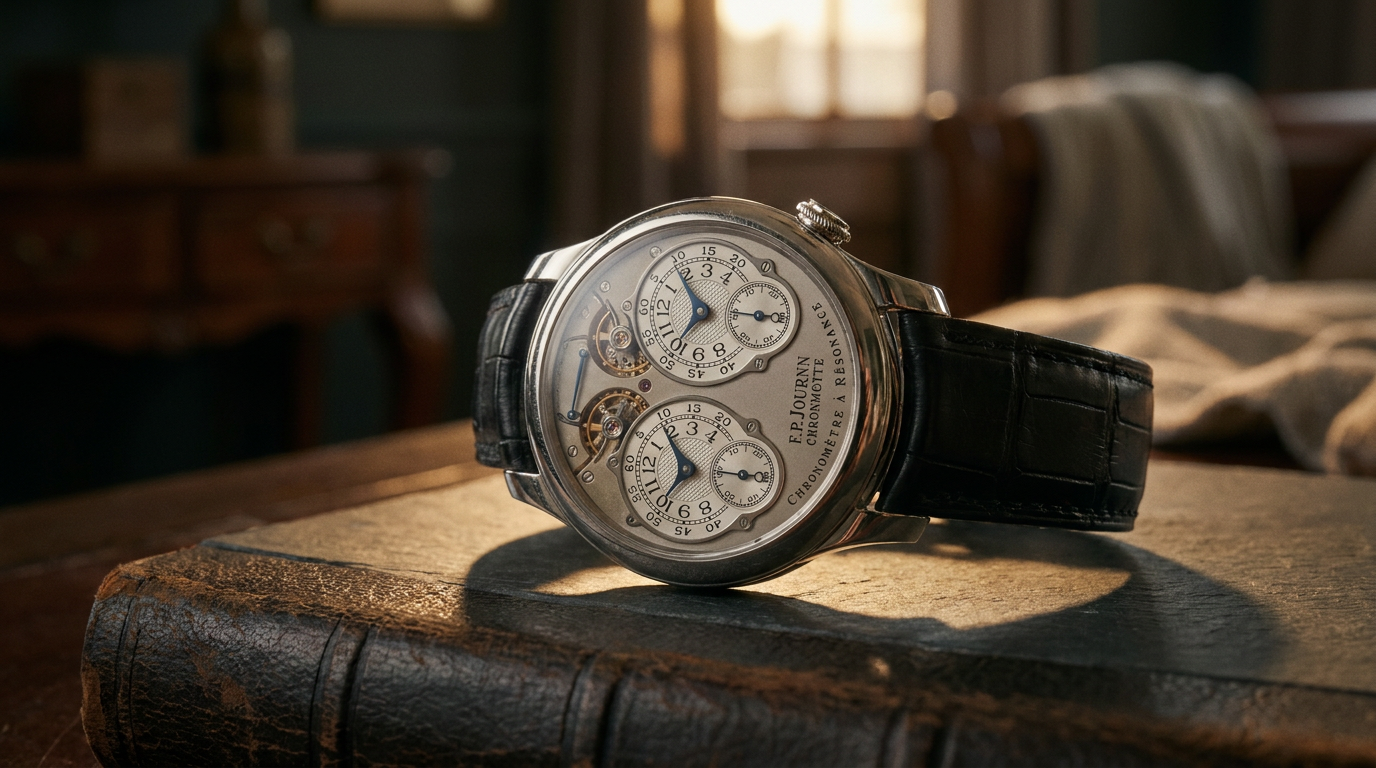
'''The air in the F.P. Journe manufacture, high above the lake in Geneva, is not thick with the scent of oil and metal, as one might imagine. It is clean, quiet, and studious, more akin to a laboratory than a workshop. It was here, in this hushed environment, that I finally collected a piece I have long pursued — the Chronomètre à Résonance. To hold it is to feel the presence of a profound horological intelligence. It is heavier than it looks, dense with platinum and purpose. On the wrist, it does not merely tick; it offers a subtle, binaural beat, the sound of two hearts finding a common rhythm. This is the sound of resonance, a principle that has fascinated and frustrated the world's greatest watchmakers for over three centuries. François-Paul Journe did not invent the concept, but he is the one who finally perfected it for the wrist.
The Pursuit of an Antique Theory
The story begins not in Geneva, but in The Hague. In 1665, the great Dutch horologist Christiaan Huygens, confined to his room by a minor illness, noticed something peculiar. Two of his new pendulum clocks, hanging from the same beam, had synchronized their swings. No matter how he started them, within a half-hour they were beating as one, a silent conversation passing between them through the wooden structure. He had stumbled upon acoustic resonance. For the next century and a half, this phenomenon remained a curiosity, a ghost in the machine. It was not until the late 18th century that Antide Janvier and, most famously, Abraham-Louis Breguet, attempted to harness it. Breguet built a handful of magnificent, and magnificently complex, pocket watches for clients like King George IV, believing that two resonating balance wheels would naturally correct each other's errors. The theory was sound, but the execution was fiendishly difficult. For nearly two hundred years after Breguet, the pursuit lay dormant, a challenge too great for lesser talents. It took a mind like Journe's, steeped in the traditions of 18th-century horology yet fiercely independent, to resurrect the challenge. He spent years studying Breguet's work, building his first prototype in 1983 before finally presenting a finished watch at Baselworld in 2000. It was a declaration of intent: that the foundational principles of physics and the highest arts of watchmaking could still produce something entirely new.
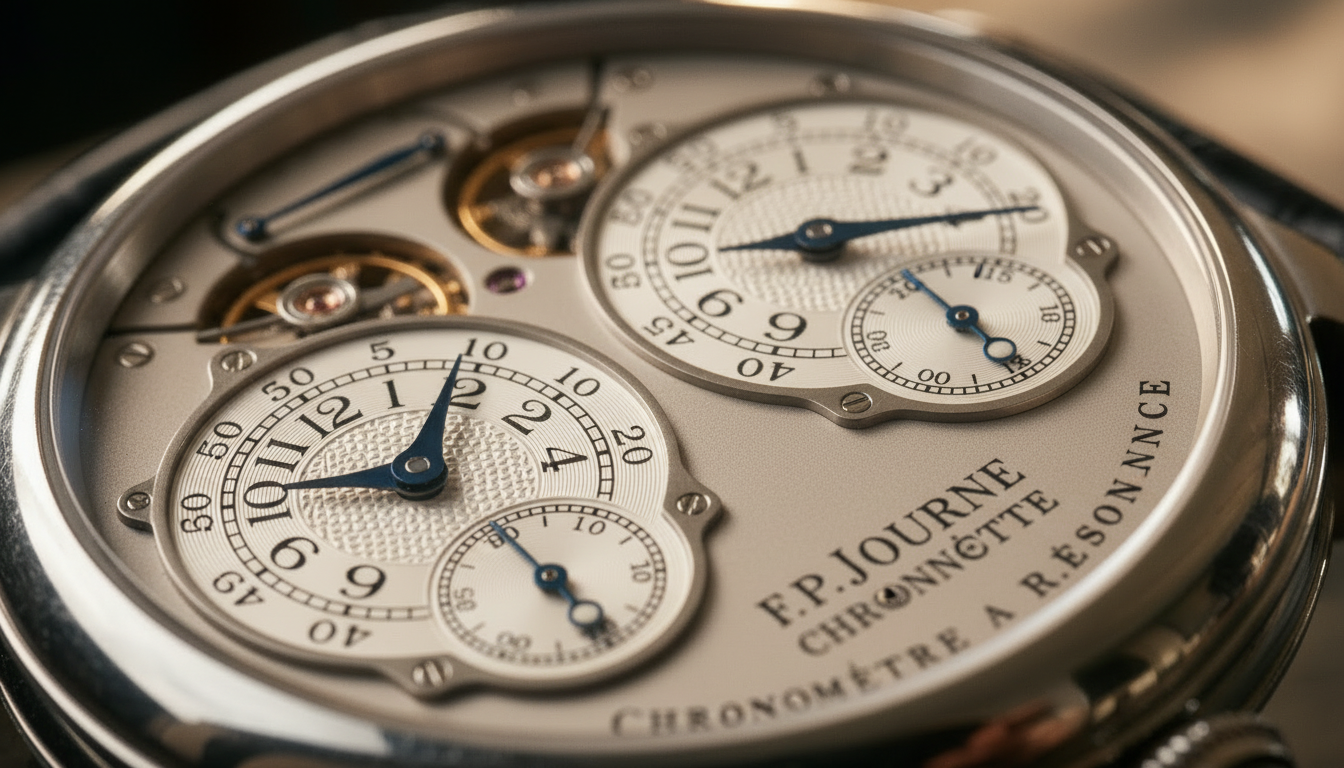
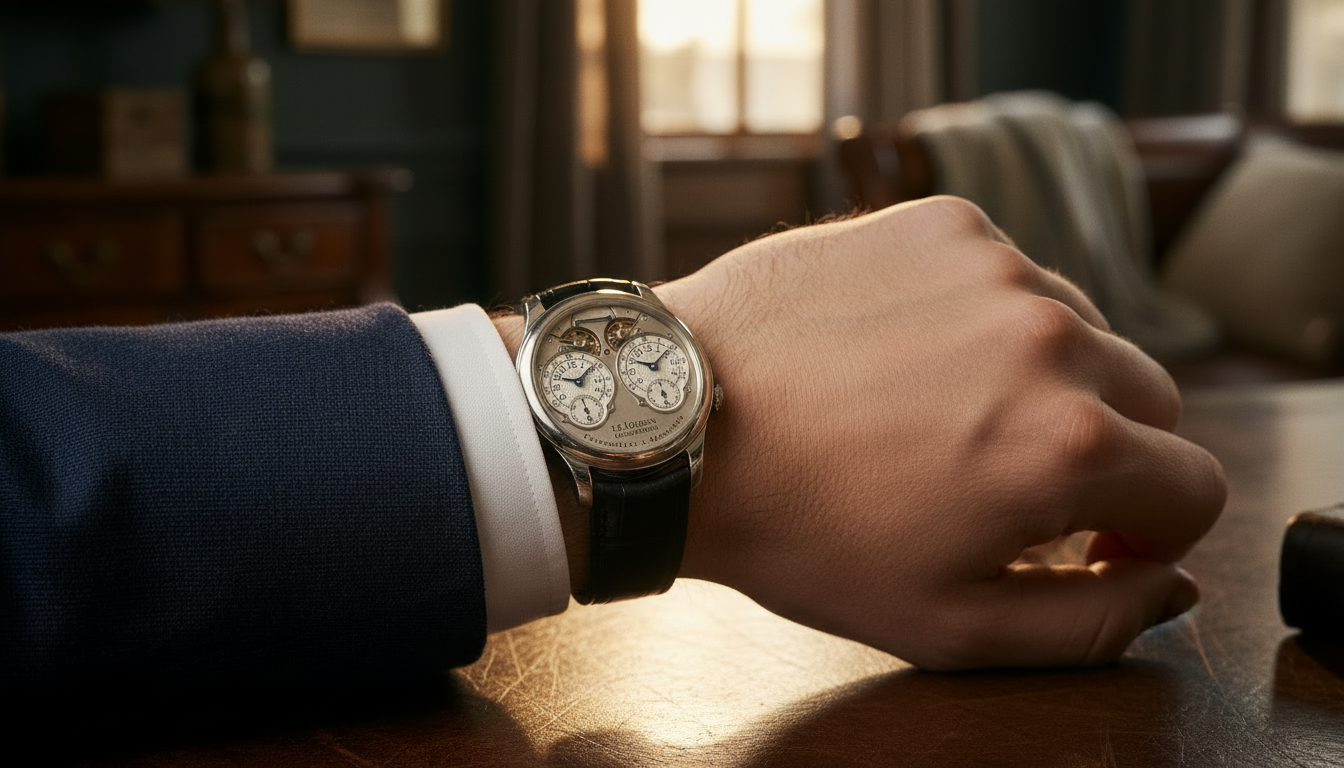
The face of the Chronomètre à Résonance is an exercise in elegant asymmetry. My own piece, with a platinum case and white gold dial, presents two silver guilloché subdials. The one on the right tells the local time; the one on the left is set to a second time zone, a silent companion for my travels. Between them, at the twelve o'clock position, sits the power reserve indicator, reading a proud 40 hours when fully wound. But the true theatre is at the bottom of the dial. Behind a cut-out, two balance wheels are exposed, the twin hearts of the watch. They appear to beat independently, yet one knows they are locked in a complex, invisible dance. Reading the time becomes a secondary pleasure to simply observing this mechanical ballet. It is a dial that rewards study, revealing layers of texture and finish that a quick glance will never appreciate.
The Calibre 1499.3
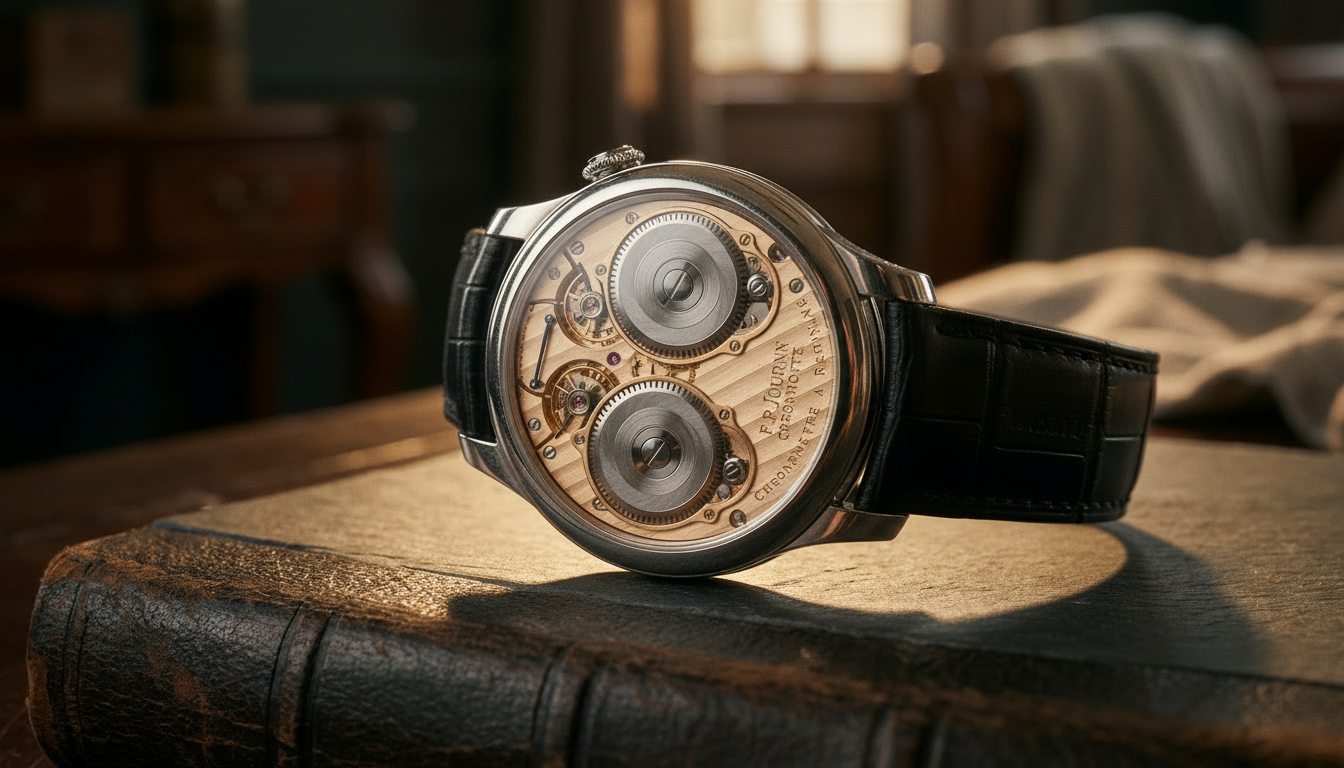
Turning the watch over reveals the source of its magic. Through the sapphire exhibition back, the Calibre 1499.3 is displayed in all its glory. As is his signature, Journe has crafted the entire movement from 18-karat rose gold, a warm and luxurious choice that stands in stark contrast to the traditional rhodium-plated brass of almost every other watchmaker. It is a visual statement, a mark of uncompromising quality. Here, the theory of resonance becomes tangible. The two balance wheels are situated less than a millimeter apart. As each one oscillates, it displaces a tiny amount of air, creating a wave of energy. Its partner, situated so closely, absorbs this energy, which subtly influences its own oscillation. Over a short period, they force each other into a state of sympathetic resonance, beating in perfect opposition. Any small error in the rate of one balance—caused by a shock or a change in position—is automatically corrected by the regulating effect of the other. The result is a stability and precision that a single-balance watch, no matter how well-adjusted, can never quite achieve. Winding the watch is a tactile pleasure, and pulling the crown at the four o’clock position sends both seconds hands snapping back to zero, a feature of immense and satisfying utility.
A Collector's Perspective
To wear a Résonance is to be initiated into a select circle of horological appreciation. It does not shout for attention like a brightly-coloured ceramic bezel or an oversized case. Its appeal is quieter, more intellectual. It is a watch that speaks not of wealth, but of knowledge. On more than one occasion, I have found it to be a key, unlocking conversations with fellow enthusiasts who recognise it for what it is: a piece of mechanical art. It represents a commitment to the craft, a belief that even in our digital age, there is value in a machine that solves a complex physical problem with nothing more than springs, gears, and levers. It is the antithesis of the disposable, the mass-produced. It is a legacy, built by one man’s singular vision, intended to last for generations. The weight of the platinum case on my wrist is a constant, pleasant reminder of this. It is substantial without being cumbersome, its 40mm diameter and slim profile allowing it to slide easily under the cuff of a well-made shirt. The alligator strap is supple, conforming to the wrist as if made for it alone. It is, in every sense, a watch for a gentleman. It does not define the man, but it certainly complements him.
In the end, the Chronomètre à Résonance is more than a watch. It is a philosophical statement. It is a testament to the idea that beauty and technical brilliance are not mutually exclusive. It connects the wearer to a lineage of great watchmakers, from Huygens to Breguet to Journe himself. To look at its dial is to be reminded that even in the measurement of something as constant as time, there is room for poetry, for dialogue, for a perfectly synchronized duet. It is a rare and wonderful thing, and a privilege to witness.
'''