Bianco over Blu: The Lamborghini Countach LP400
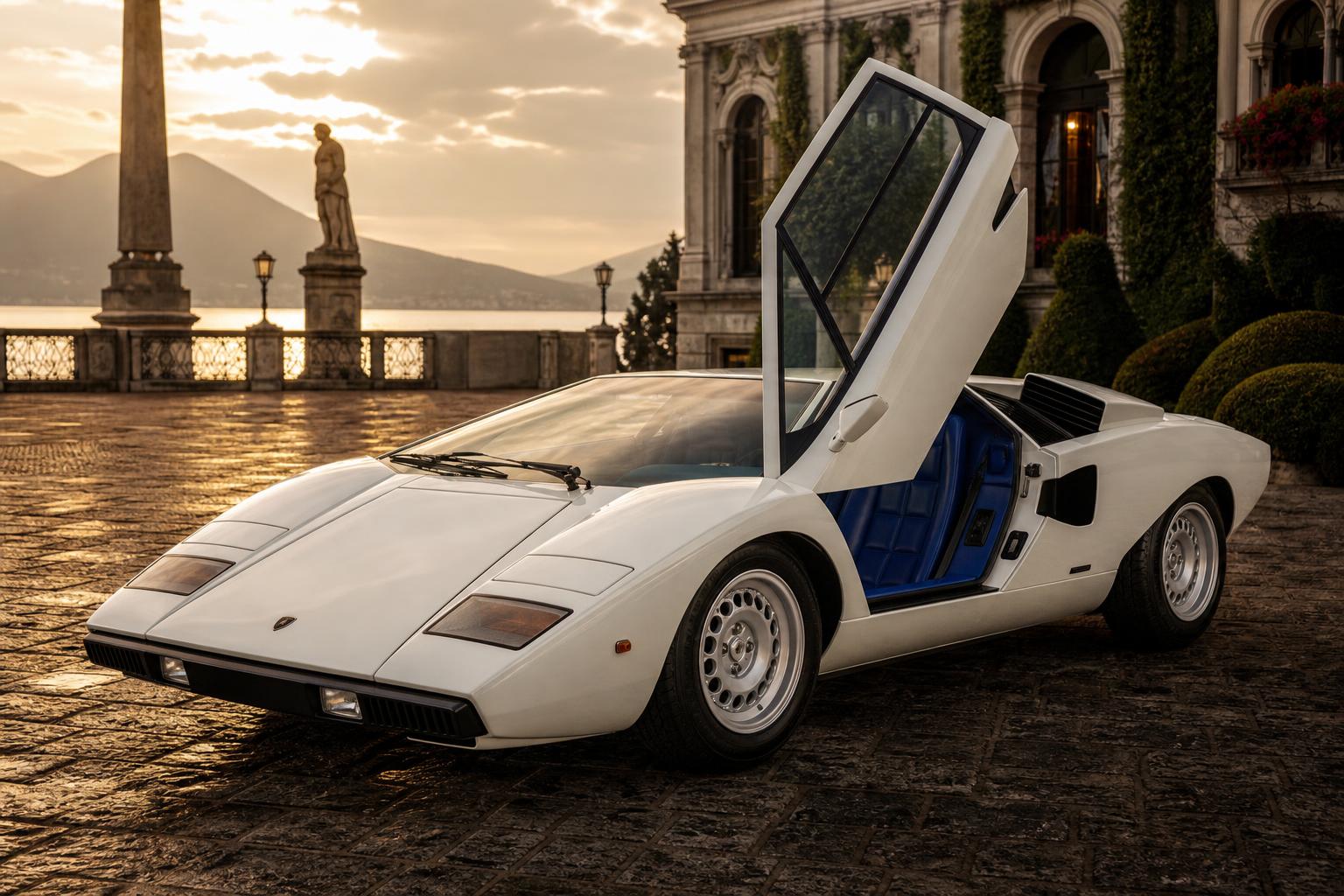
A 1976 Lamborghini Countach LP400 'Periscopio' in Bianco, trimmed in Blu Elettrico leather. On the connoisseur's Countach, Marcello Gandini's wedge at its most pure, and the particular drama of a white car with blue seats.
There is a Countach, and then there is the Countach. The poster on every adolescent bedroom wall of the 1980s was almost certainly an LP500S, or the later 5000 QV, or the great winged 25th Anniversary — cars that grew progressively wider, louder and more theatrical until, in the end, they became a caricature of themselves. The connoisseur, however, looks past all of that. The connoisseur looks at the original. He looks at an LP400.
The LP400 was the first production Countach. Built in Sant'Agata Bolognese between 1974 and 1978, it survived in just one hundred and fifty-seven examples. It is the purest expression of what Marcello Gandini drew at Bertone and what Paolo Stanzani built underneath — a car so radical that, half a century on, it still looks as though it has arrived from a more confident future. Specify one in Bianco over Blu Elettrico leather, as the factory occasionally did, and you have something close to the platonic ideal of the post-war Italian supercar.
The Wedge, Undiluted
Look at an LP400 alongside any later Countach and the difference is instantly apparent. There are no flared arches. There are no riveted-on box flares. There is no rear wing dramatising the silhouette. There is only the wedge — low, narrow, impossibly clean, riding on slender Campagnolo telephone-dial wheels that look almost dainty by modern standards. The line that runs from the leading edge of the bonnet to the tip of the rear deck is one of the great unbroken gestures in automotive design, a single confident slash of paint and glass.
Gandini was thirty-five when he finished the drawings. He had already given the world the Miura, the Lancia Stratos Zero and the Alfa Romeo Carabo. The Countach was, even by his standards, a provocation. Its name is the Piedmontese exclamation a craftsman supposedly let slip when he first saw the prototype — somewhere between good lord and an unprintable expletive. The car required new vocabulary. The scissor doors, opening vertically because the sills were too wide to permit anything else, were not styling. They were necessity made beautiful.
The Periscope on the Roof
It is the small detail that gives this series its nickname. Early LP400 buyers, sitting low in a cabin with nearly no rear visibility to speak of, were offered the consolation of a curious rectangular tunnel cut into the roof above the driver's head, with a mirror at each end. Looking up through it, one could just about glimpse what was happening behind. It was not, by any honest reckoning, much use. It was also discontinued within a few years, which is precisely why "Periscopio" — periscope — became the collector's shorthand for the original car. To own a Periscopio is to own a Countach with a story carved literally into its roofline.
Stanzani's Twelve
If Gandini's contribution was the shape, Paolo Stanzani's was the engineering, and it was no less audacious. The Bizzarrini-derived 3.9-litre V12 was rotated through ninety degrees and mounted longitudinally behind the driver, with the gearbox sitting forward of the engine, between the seats. This was done so that the gear linkage could be short, direct and mechanical — three things Lamborghini believed mattered more than convenience. Drive ran rearwards through a tunnel beneath the engine's sump to the rear axle. It was, characteristically, the harder way to do it. It was also, characteristically, the right way to do it.
The result was three hundred and seventy-five horsepower, six twin-choke Weber 45 DCOEs, and an exhaust note that even today is difficult to describe in polite company. The LP400 weighed only 1,065 kilograms dry. It would reach 300 km/h at a time when the rest of the world considered 250 a remarkable achievement.
Why Bianco over Blu
Period photographs of LP400s tend, mercifully, to avoid the lurid oranges and bilious greens that consumed the rest of the decade. The factory understood, even then, that a shape this dramatic demanded a quiet exterior. The most evocative of all the original specifications — debated endlessly among the small fraternity of LP400 owners — is Bianco over Blu Elettrico: a brilliant, almost ecclesiastical white outside, and an interior trimmed entirely in electric blue leather. Blue seats, blue door cards, blue dashboard, blue carpets.
The combination should not work, and it works completely. The white reads as sculpture, an undecorated mass of paint stretched over Gandini's lines. The blue, when the scissor door rises and the cabin is suddenly revealed, is a sudden, intimate piece of theatre — the equivalent of a Savile Row jacket lined in unexpected silk. It is also period-correct: electric blue leather was a recognised Lamborghini interior option in the mid-1970s, used sparingly and almost always on white or silver cars. Find such an example today, properly preserved, and it will be the quietest Countach at any concours field and, simultaneously, the one no one can stop looking at.
The Connoisseur's Countach
The market has, in its slow and reliable way, arrived at the same conclusion. The LP400 has overtaken every subsequent Countach in value, and the gap continues to widen. The reasons are the obvious ones — rarity, originality, the purity of Gandini's first thought — but the deeper reason is more straightforward. The LP400 is the only Countach that asks nothing of you. It does not perform. It does not pose. It simply sits, low and bright and improbable, on its narrow wheels, and waits.
Open the door, fold yourself into the blue leather, turn the key and listen to that V12 catch behind your head. The shape outside is half a century old. The car you are sitting in feels older than that and, somehow, newer than anything built since. Some objects age. The Countach LP400 in Bianco over Blu does not. It simply continues to be the answer to a question almost nobody is brave enough to ask any more.