An Argentinian in Modena
The De Tomaso Mangusta was a flawed masterpiece of breathtaking beauty and Italo-American ambition. Its story is one of breathtaking design and dynamic intransigence.
The Shadow of the Serpent
In the late 1960s, Modena was the undisputed crucible of the supercar. The air hung heavy with the scent of high-octane fuel and the sounds of thoroughbred Italian engines being tested to their limits. Amidst the established titans of Ferrari and Maserati, a formidable new force was making its presence felt. This was the world of Alejandro de Tomaso, the audacious Argentinian industrialist with a singular, all-consuming ambition: to out-manoeuvre Enzo Ferrari himself.
De Tomaso was a man of complex motivations, a former racing driver with a keen instinct for both engineering and commerce. His vision was a fusion of Italian design flair and dependable American power, a combination he believed could create a new breed of grand tourer. The Mangusta, Italian for mongoose—an animal known for its ability to dispatch cobras—was the most potent realisation of this vision, and its name a not-so-subtle nod to a failed collaboration with Carroll Shelby.
A Study in Tension
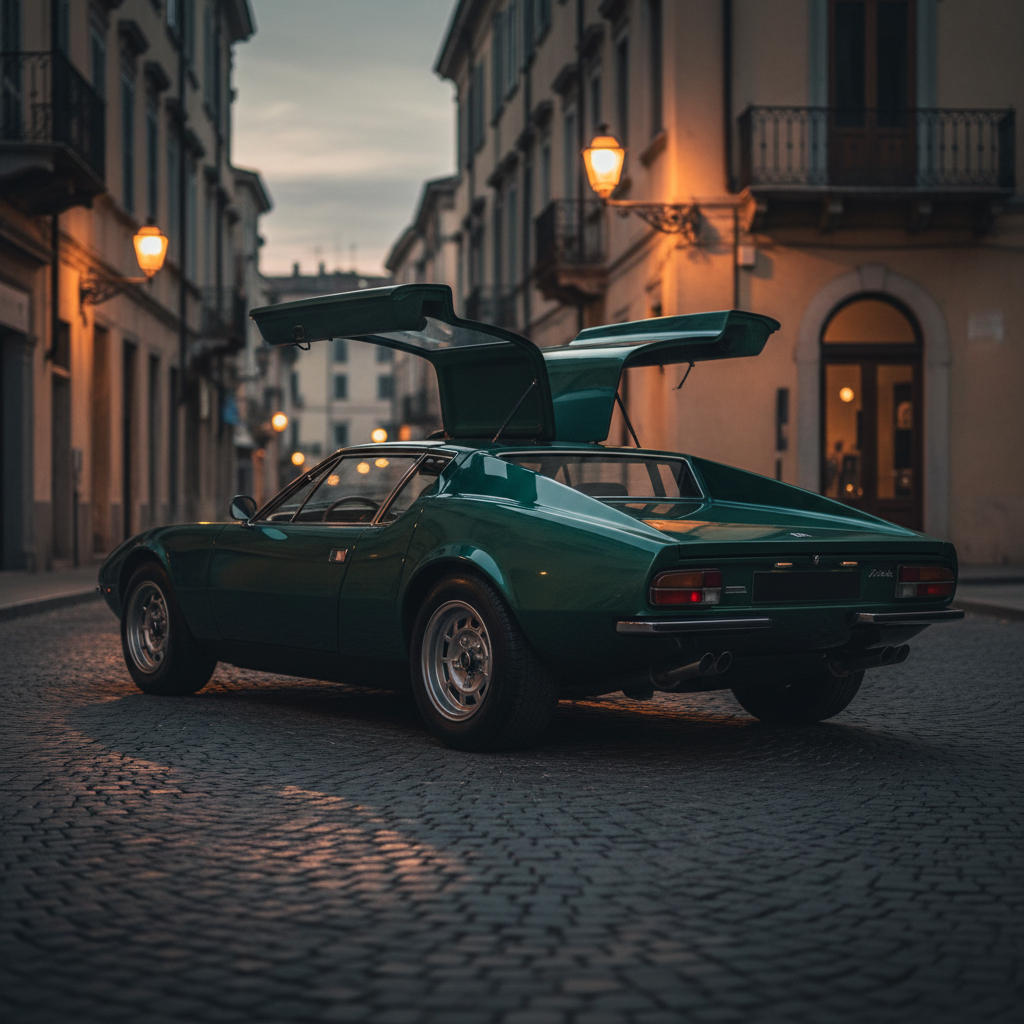
The Mangusta’s genesis is a tale of repurposed ambition. The chassis was a spine of steel, originally intended for the De Tomaso P70 sports-prototype, a project with Shelby that had soured. With the chassis lying dormant, De Tomaso turned to a young Giorgetto Giugiaro, then at Ghia, to clothe it. The result was nothing short of breathtaking, a masterclass in proportion and line. The Mangusta sat impossibly low and wide, its most dramatic feature being the centre-hinged gullwing doors that opened like a carapace to reveal the engine and rear mechanicals. It was a piece of automotive theatre that few cars before or since have managed to replicate, a design of pure, unadulterated aggression and elegance.
The heart of this Italian sculpture was a thumping American V8, typically a Ford 289 or 302. This provided the car with immense, readily available torque and a soundtrack that was more hot rod than haughty grand tourer. It was this juxtaposition of brutalist power and delicate, almost fragile, beauty that defined the Mangusta. It was a car that looked like it was doing 200 miles per hour even when standing perfectly still, a testament to Giugiaro’s genius.
The Flawed Jewel
For all its aesthetic perfection, the Mangusta was a notoriously challenging motorcar to drive. The steel backbone chassis, while effective for a racing prototype, lacked the torsional rigidity required for a road car, particularly one with such a rear-heavy weight distribution of 32/68. This imbalance, combined with the primitive suspension geometry of the era, conspired to create a machine with treacherous high-speed manners. To drive a Mangusta with spirit was to enter into a dialogue with a machine that held its own very strong opinions.
And yet, for the man who understands such things, this is the very essence of the Mangusta’s appeal. It is not a car for the uninitiated. It demands respect, a firm hand, and a deep understanding of vehicle dynamics. To pilot one is to experience the raw, unfiltered nature of the 1960s supercar—a time when beauty often took precedence over balance, and driver skill was the final, essential component. The Mangusta was a flawed jewel, perhaps, but a jewel nonetheless. It stands today as a monument to a specific moment in time, a testament to the fiery ambition of its creator and the sublime artistry of its designer. It is, and will remain, an Argentinian masterpiece from the heart of Modena.