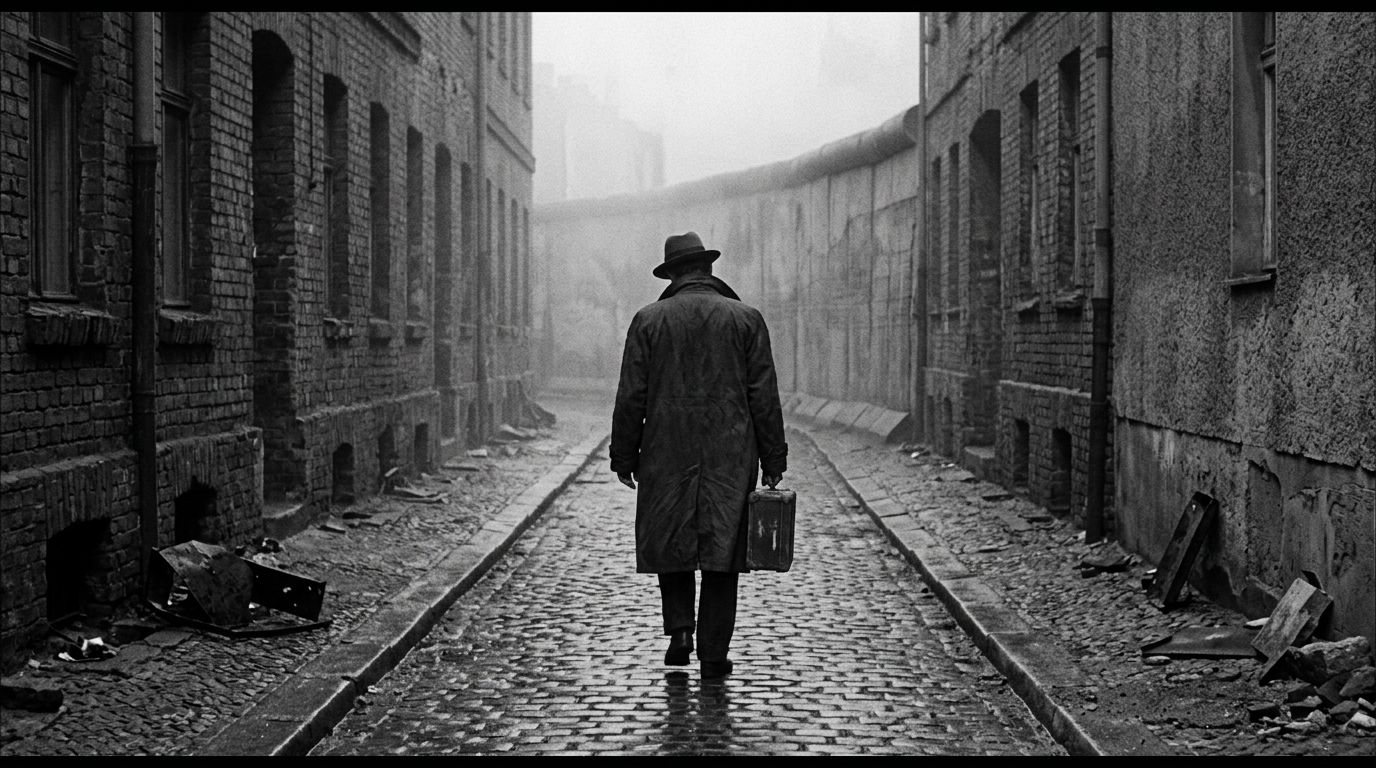
Original interpretation — not a still from the production
A masterpiece of Cold War espionage, stripping away glamour to reveal the bleak, morally corrosive reality of intelligence work.
The Continental Verdict
Essential
Martin Ritt's stark 1965 adaptation of John le Carré's seminal novel remains, nearly six decades on, the definitive cinematic portrayal of Cold War espionage. Filmed in an exquisite, chiaroscuro black and white, it plunges the viewer into a world devoid of heroism, where loyalty is a commodity and moral compromise is the only currency. Richard Burton's Alec Leamas is a spent man, his cynicism a thin veneer over profound weariness, tasked with one final, seemingly straightforward mission that spirals into a labyrinth of betrayal and double-crosses. The film's brilliance lies in its unflinching portrayal of the intelligence agencies themselves, as detached and merciless as the adversaries they pursue, grinding individuals into dust for the sake of an abstract game.
Set predominantly in a grim, divided Berlin and a surprisingly provincial London, the film eschews the familiar Bondian gloss for an aesthetic of bureaucratic shabbiness and existential dread. The meticulous screenplay by Paul Dehn and Guy Trosper captures the labyrinthine complexities of le Carré's narrative without sacrificing its emotional weight. While Leamas's journey is one of disillusionment and ultimate despair, the film’s profound statement on the moral equivalence of the warring ideologies resonates powerfully. It is a work of exceptional dramatic integrity, an antidote to any romantic notions of spycraft, and a potent reminder that the real battles are often fought in the shadows, by men who have long since forgotten what they are fighting for.
Why Watch It
The Gentleman Factor
The gentleman takes from this film a profound understanding of the moral complexities inherent in geopolitical conflict. It is a cautionary tale against simplistic binaries and a meditation on the cost of unwavering commitment to a cause, often at the expense of one’s soul. It teaches that even in the most clandestine of worlds, personal integrity, however compromised, can still hold tragic sway.
Look Out For
- British black and white cinematography
- Post-war austerity
- German expressionism
The Locations
Berlin Wall, East Berlin, West Berlin, London, England, various drab offices and safe houses across Germany and the UK.
More from the travel pages →The Cars
No prominent vehicles feature.
More from motoring →The Wardrobe
Ruth Myers’s costuming is exemplary in its understated realism. Leamas’s worn trench coats and rumpled suits speak volumes of his weariness. The clothes are functional, sombre, and reflect the prevailing austerity of post-war Britain and the grim pragmatism of divided Germany.
More on style →The Soundtrack
Sol Kaplan’s score is sparse and haunting, perfectly complementing the film’s bleak atmosphere without ever becoming intrusive. It underscores the tension and melancholy with subtle instrumentation.
Into the music room →Watch Next
Where to Watch
Available for streaming and purchase on various digital platforms; Blu-ray and DVD editions are readily available.
For the Collection
Also in Espionage
As an Amazon Associate I earn from qualifying purchases. Links cost you nothing and never influence what we recommend. Recommendations are honest and never paid for. Imagery is an original interpretation, not a still from the production.