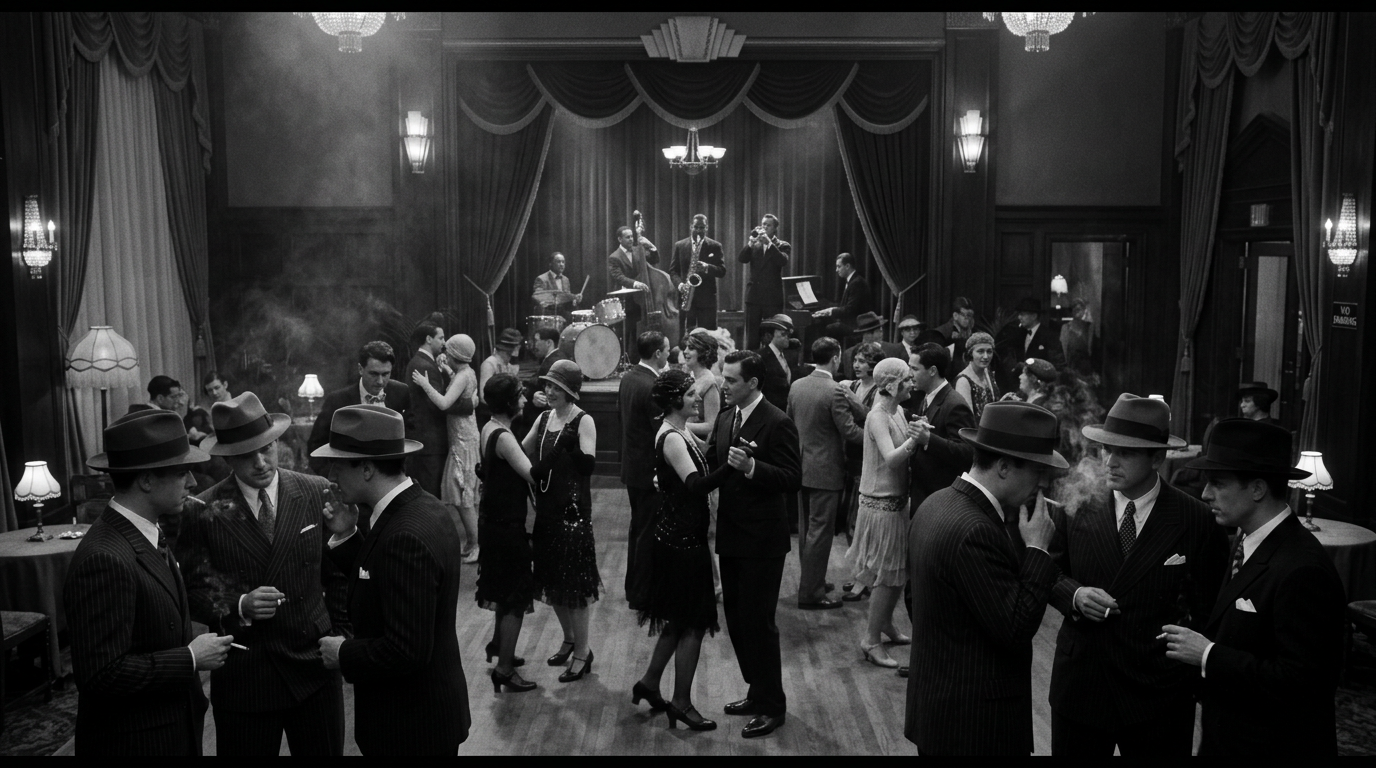
Original interpretation — not a still from the production
Two jazz musicians, on the run from the mob, disguise themselves as women and join an all-female orchestra heading to Florida. Mayhem, romance, and some of cinema's most indelible comic performances ensue.
The Continental Verdict
Essential
Billy Wilder’s "Some Like It Hot" remains, over six decades since its premiere, a masterclass in comic timing, characterisation, and subversive wit. The premise—two down-on-their-luck musicians, Joe and Jerry, witness a mob hit and flee by joining an all-female band as Josephine and Daphne—is fertile ground for farce, yet Wilder, with his customary incisiveness, elevates it beyond mere slapstick. The screenplay, penned with I.A.L. Diamond, navigates gender roles and identity with a lightness of touch that belies its thematic depth, while never sacrificing a single laugh. Marilyn Monroe, as the breathy Sugar Kane, delivers perhaps her most charming performance, a blend of vulnerability and effervescent allure that anchors the romantic heart of the film. Tony Curtis and Jack Lemmon, meanwhile, are a formidable duo, their chemistry undeniable whether they are bickering in drag or navigating the intricacies of their double lives.
The film’s enduring appeal lies not only in its relentless humour but also in its surprisingly tender exploration of loneliness, desire, and the search for belonging. The supporting cast, from George Raft's menacing Spats Colombo to Joe E. Brown's lovestruck Osgood Fielding III, are perfectly calibrated, each adding another layer to the organised chaos. Filmed in glorious black and white, the cinematography captures the era’s glamour and grit, transitioning seamlessly from the Prohibition-era Chicago underworld to the sun-drenched, if slightly seedy, exuberance of a Florida resort. "Some Like It Hot" is a testament to the power of intelligent comedy, a film that continues to entertain, provoke, and delight with each viewing.
Why Watch It
The Gentleman Factor
The perennial necessity of keeping one's wits about one, even when the situation is entirely beyond one's control. And the subtle art of tailoring, even when dealing with ill-fitting garments and an assumed identity. The film also provides an amusing, if exaggerated, look at the intricacies of relationships and the lengths one might go to for love or self-preservation.
Look Out For
- Prohibition-era Chicago nightlife
- Florida beach resorts of the 1920s
- Art Deco hotel interiors
The Locations
Chicago, Illinois (primarily studio sets for interiors and establishing shots); Coronado, California (Hotel del Coronado for the exterior of the "Seminole Ritz Hotel" in Florida).
More from the travel pages →The Cars
A 1928 Cadillac Town Sedan (used by Spats Colombo's gang); various other period automobiles typical of 1929.
More from motoring →The Wardrobe
The film's costumes, particularly those worn by Tony Curtis and Jack Lemmon in drag, are central to its humour and plot. Orry-Kelly, the costume designer, created both the flapper dresses for "Josephine" and "Daphne," often with exaggerated details for comic effect, and the alluring, form-fitting gowns for Marilyn Monroe's Sugar Kane. The men's wardrobes reflect the era's jazz musicians, while the mobsters are impeccably, if menacingly, dressed in dark suits and fedoras.
More on style →The Soundtrack
Adolph Deutsch's score masterfully blends jazz standards of the era with original compositions, creating a vibrant, period-appropriate soundscape. Marilyn Monroe's renditions of "I Wanna Be Loved by You," "I'm Through With Love," and "Some Like It Hot" are iconic, imbued with her inimitable vocal style.
Into the music room →Watch Next
Where to Watch
Available for streaming on various platforms and on Blu-ray/DVD.
For the Collection
Also in Continental Cinema
As an Amazon Associate I earn from qualifying purchases. Links cost you nothing and never influence what we recommend. Recommendations are honest and never paid for. Imagery is an original interpretation, not a still from the production.