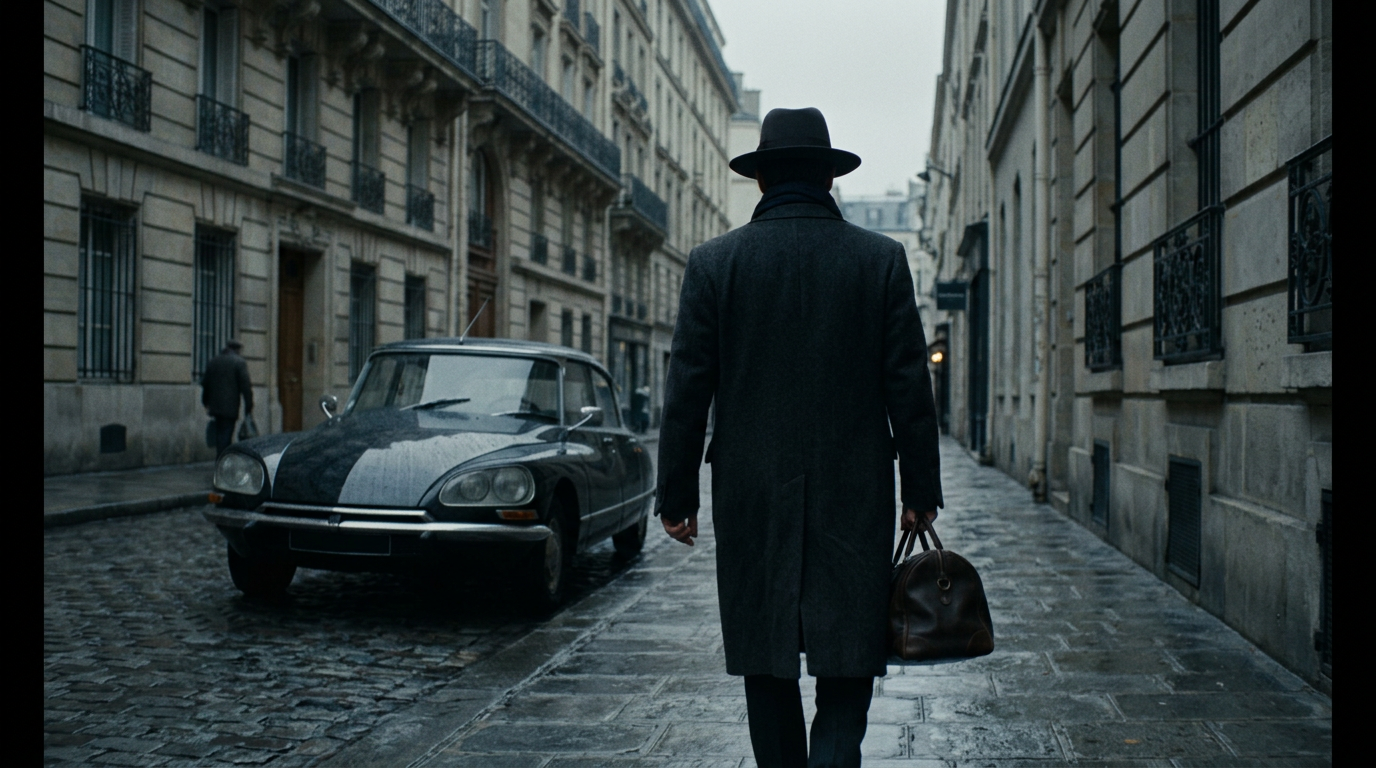
Original interpretation — not a still from the production
Alain Delon as Jef Costello, a contract killer whose meticulously ordered world unravels after a job goes awry. A study in isolation, precision, and existential cool.
The Continental Verdict
Essential
Jean-Pierre Melville’s 1967 masterwork, *Le Samouraï*, presents Alain Delon at the apex of his understated power as Jef Costello, a contract killer operating in a meticulously choreographed universe of his own making. From the opening shot – Costello reclining in his sparse, monastic apartment, a caged bird his only companion – Melville establishes a tone of profound solitude and ritual. The film unfolds with a balletic grace, each frame composed with an almost architectural precision, reflecting Costello’s own rigid code. His movements are spare, his dialogue minimal, yet Delon communicates volumes through a glance, a gesture, the subtle tilt of his fedora. This is not merely a crime drama; it is a philosophical treatise on fate, honour, and the solitary nature of man, played out against the stark, grey backdrops of Parisian life.
The film’s influence on the crime genre is incalculable, establishing a template for the stoic, professional hitman that would be emulated for decades. Melville strips away all extraneous detail, focusing on procedure and the psychological landscape of his protagonist. The narrative tension is sustained less by traditional plot points and more by the impending sense of doom that hangs over Costello, an inevitable consequence of his chosen path. François de Roubaix’s haunting score, with its sparse, melancholic motifs, underscores this fatalism, while the elegant simplicity of the cinematography elevates the proceedings beyond mere genre fare. *Le Samouraï* remains a benchmark for cinematic style and a profound exploration of the modern anti-hero.
Why Watch It
The Gentleman Factor
A profound meditation on adherence to a personal code, the burdens of reputation, and the dignity in facing an inevitable end. Costello’s disciplined routine and sartorial precision offer an austere lesson in self-possession.
Look Out For
- The quiet discipline of a lone wolf.
- Mid-century Parisian urban cool.
- Stylised neo-noir atmosphere.
The Locations
Paris, including its shadowy streets, train stations, and jazz clubs.
More from the travel pages →The Cars
Citroën DS, Peugeot 404
More from motoring →The Wardrobe
Alain Delon's iconic trench coat, fedora, and impeccably tailored suits by Pierre Cardin. Nathalie Delon's sophisticated Parisian chic.
More on style →The Soundtrack
Sparse, melancholic, and atmospheric score by François de Roubaix, featuring subtle jazz motifs.
Into the music room →Watch Next
Where to Watch
Available on Criterion Collection Blu-ray and select streaming platforms.
For the Collection
Also in The Criminal Gentleman
As an Amazon Associate I earn from qualifying purchases. Links cost you nothing and never influence what we recommend. Recommendations are honest and never paid for. Imagery is an original interpretation, not a still from the production.