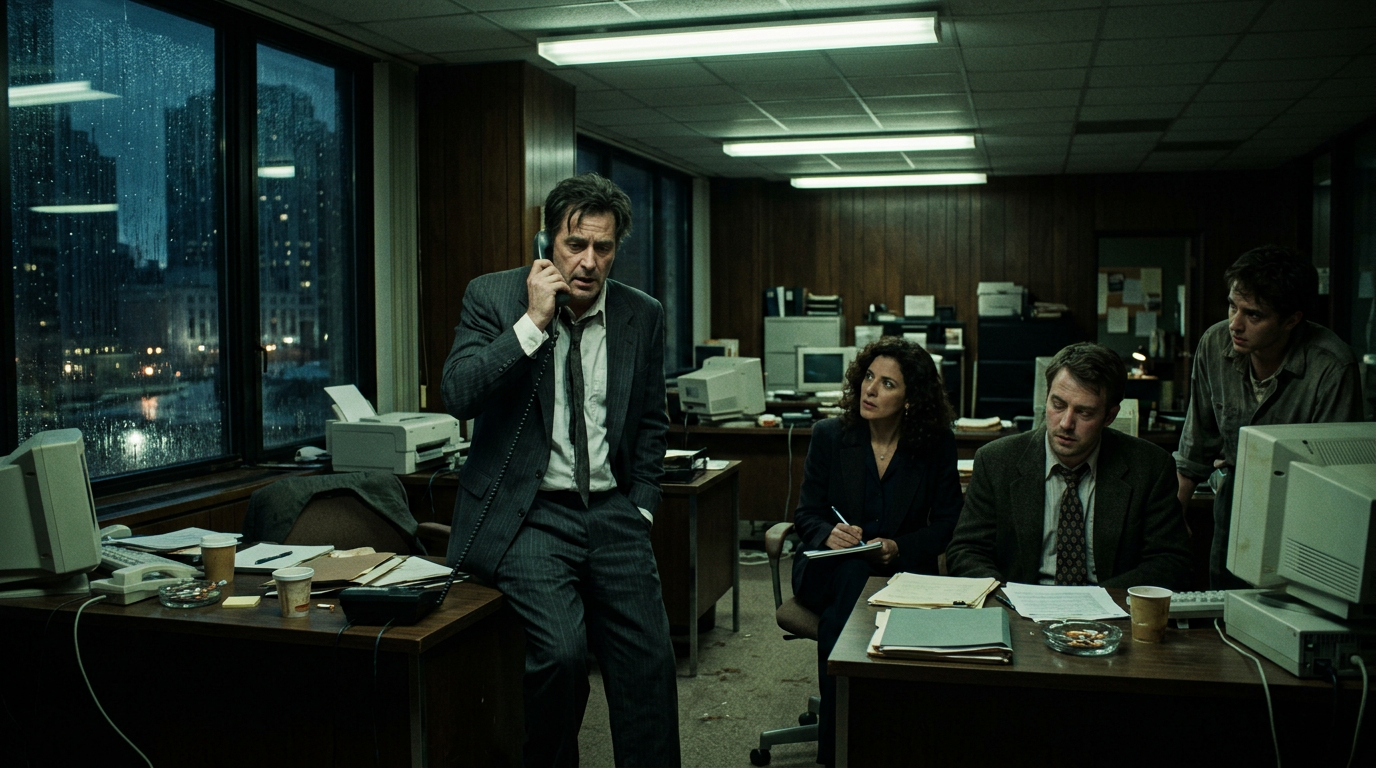
Original interpretation — not a still from the production
An unvarnished portrait of desperation in the cut-throat world of Chicago real estate, where men are made and broken by the monthly sales board.
The Continental Verdict
Essential
David Mamet's adaptation of his own Pulitzer Prize-winning play is a masterclass in tension, delivering a blistering, often uncomfortable, examination of masculinity under duress. Director James Foley eschews theatricality for a stark, claustrophobic realism, trapping his stellar ensemble cast within the confines of a perpetually beleaguered real estate office and the sterile, rain-slicked streets of Chicago. The film’s power lies not just in Mamet's razor-sharp, rhythmic dialogue – a language of competitive aggression and thinly veiled fear – but in the palpable anxiety that permeates every frame, charting the precipitous decline of men once kings of their domain, now reduced to begging for leads.
The ensemble is nothing short of extraordinary. Al Pacino, as the slick Ricky Roma, delivers a performance of mesmerising intensity, a charismatic predator and an unlikely philosopher of the sales pitch. Jack Lemmon, as the fading Shelley "The Machine" Levene, evokes a profound pathos, his desperation a raw wound. Ed Harris, Alan Arkin, Kevin Spacey, and Jonathan Pryce each contribute to this grim ballet of ambition and despair, sketching characters who are both repellent and tragically human. It is a world where camaraderie is a fleeting illusion, replaced by a brutal, Darwinian struggle for survival within the capitalist machine, perfectly encapsulating the moral ambiguities of "always be closing".
Why Watch It
The Gentleman Factor
The gentleman learns not to become one of these men, and crucially, how *not* to treat men who find themselves in such circumstances. It is a cautionary tale about the perils of ambition untethered from ethics, and the slow, grinding destruction of dignity. Observe the sharp tailoring as a last defence against personal dissolution.
Look Out For
- The brutalism of corporate 1980s architecture contrasted with the melancholic glow of Chicago nights.
- The stark, utilitarian aesthetic of a perpetually failing sales office.
- The palpable desperation etched onto the faces of men fighting for survival.
The Locations
Chicago in the early 1990s; primarily confined to the dimly lit real estate office, with brief, tense forays into a Chinese restaurant and the heavy, rain-soaked city streets.
More from the travel pages →The Cars
The characters mostly drive non-descript, older sedans, reflecting their modest financial standing despite their aspirations. There is no specific focus on cars.
More from motoring →The Wardrobe
The wardrobe, designed by Rita Ryack, speaks volumes about the characters' attempts to maintain an image of success amidst their struggles. Suits, though often ill-fitting or slightly dated, are de rigueur – sharp Italian cuts for Roma, more traditional American styles for the older agents. These clothes serve as a desperate uniform, a final bastion of dignity against the encroaching tide of failure.
More on style →The Soundtrack
James Newton Howard's score is sparse and melancholic, an undercurrent of tension and despair that underscores the dramatic interplay without ever becoming obtrusive. The occasional jazz standard provides a brittle counterpoint to the relentless grind of the sales office.
Into the music room →Watch Next
Where to Watch
Available to stream on various platforms, and a perennial staple of cinema studies courses.
For the Collection
Also in Power & Money
As an Amazon Associate I earn from qualifying purchases. Links cost you nothing and never influence what we recommend. Recommendations are honest and never paid for. Imagery is an original interpretation, not a still from the production.