The Audemars Piguet Royal Oak 16202: A Study in Audacious Form
It defined the luxury sports watch category in 1972 with its radical steel case and integrated bracelet. Spending an afternoon with the latest "Jumbo" reveals an icon that has lost none of its disruptive, elegant power.

The light in the AP House lounge in Geneva last month was soft, filtered through tall windows overlooking the Rhône. Outside, the early summer afternoon was bright; inside, the atmosphere was one of hushed concentration. On a velvet tray before me sat a piece of design history made tangible: the Royal Oak "Jumbo" Extra-Thin, reference 16202ST. To hold it is to hold the origin story of an entire category of modern watchmaking.
The watch was passed to me with a quiet reverence that felt appropriate. Even after more than fifty years, the form retains its capacity to surprise. It is a study in controlled aggression and refined geometry, a piece born of crisis and genius that feels as contemporary today as it must have felt shocking in 1972. It is smaller and thinner than one might expect from photographs, sitting on the wrist with a lithe, balanced presence that belies its industrial-inflected aesthetics. The initial impression is not of bulk, but of an almost architectural coherence.
A Revolution in Steel
One must remember the world into which the Royal Oak was born. The Swiss watch industry was on the precipice of the quartz crisis, and the prevailing logic dictated that luxury was expressed in precious metal. The notion of a steel watch commanding a higher price than a gold one was, to put it mildly, absurd. Yet that was precisely the brief given to Gérald Genta on the eve of the 1971 Basel Fair. The apocryphal tale of a single overnight sketch has passed into legend, but the result was anything but ephemeral.
Inspired by the visible screw-heads on a classic brass diving helmet, Genta created an octagonal bezel secured by eight hexagonal, functional screws of polished white gold. This was not decoration; it was a frank admission of construction. The case itself was a monocoque design in early models, and the whole structure was angular, unapologetic, and finished with a level of detail previously reserved for movements and dials. The interplay of brushed surfaces and polished chamfers creates a dynamic dance of light that draws the eye across its unconventional lines. It was a gamble that paid off, creating the very template for the luxury sports watch and saving Audemars Piguet in the process.
The Dial as Landscape
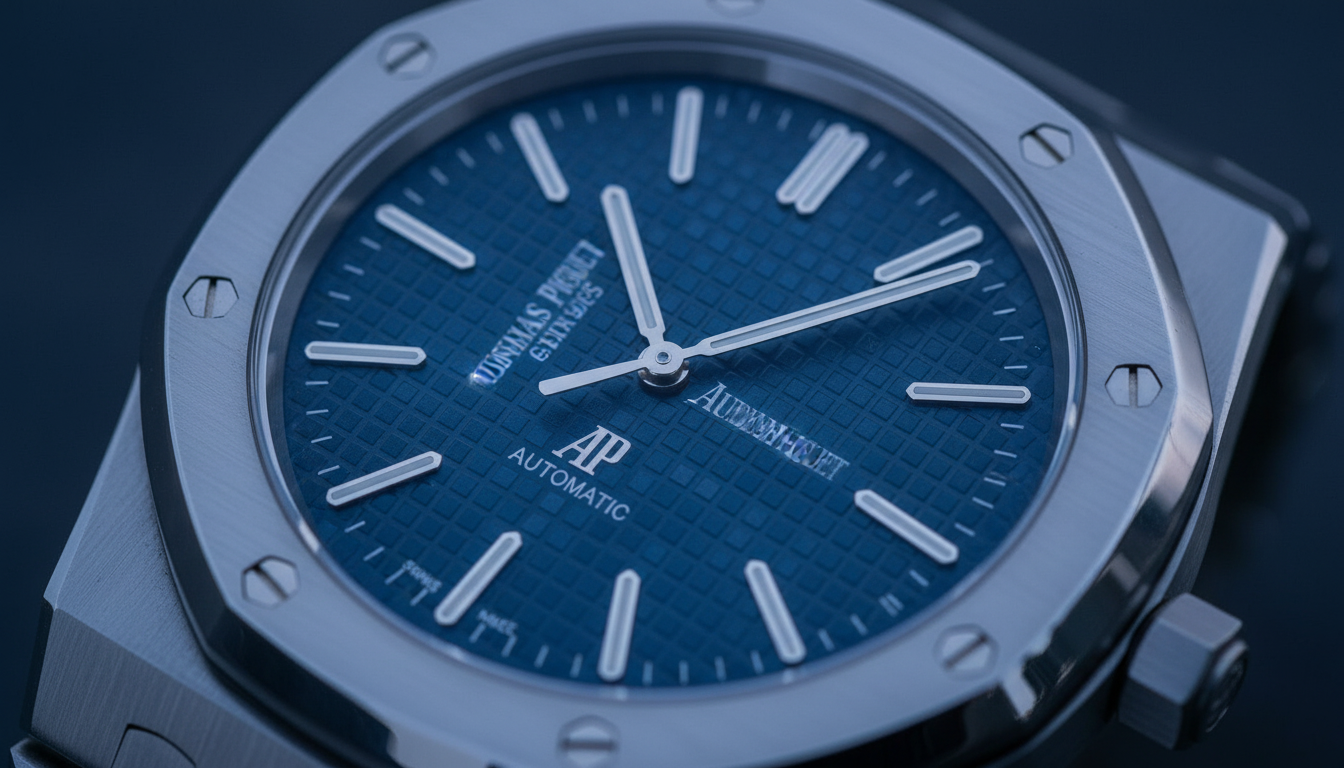
The dial, however, is where the soul of the Royal Oak resides. On this 16202, it is the iconic Bleu Nuit, Nuage 50 shade, a deep and complex blue-grey that shifts dramatically with the light. The surface is not flat but a miniature landscape of precisely machined squares, the famous Petite Tapisserie pattern. This is not a stamped texture but the result of a painstaking process using a 19th-century pantograph engine, a craft that few artisans still master.
Spending time with the watch, I found myself tilting it back and forth, watching as the tiny pyramidal forms caught and scattered the light, causing the dial to flicker from near-black to a soft, cloudy grey. The applied white gold hour markers and the signature "AP" logo at six o'clock seem to float above this textured sea. The date window, perfectly integrated, is a testament to the new calibre within, but it is the dial's living surface that commands attention. It is a masterpiece of industrial art, a grid that feels entirely organic.

The Unity of the Form
A Royal Oak is not a case with a bracelet attached; it is a single, integrated piece of sculpture. The bracelet is the masterstroke of Genta's design. It flows directly from the case, tapering elegantly towards the clasp in a cascade of interlocking, brushed links punctuated by smaller, polished connectors. The articulation is extraordinary. It conforms to the wrist with the fluidity of fabric, a cool, metallic weight that is constantly present but never cumbersome.
The complexity of its construction is immense, with each link requiring multiple finishing operations. Running a finger along its edge, you feel no sharp transitions, only a seamless flow of meticulously finished steel. The folding clasp, signed with a simple "AP," is itself a fine piece of engineering, securing the watch with a satisfying and definitive click. It is this unity of case and bracelet that makes the Royal Oak so singular. It is not worn so much as it is inhabited.
The New Heart
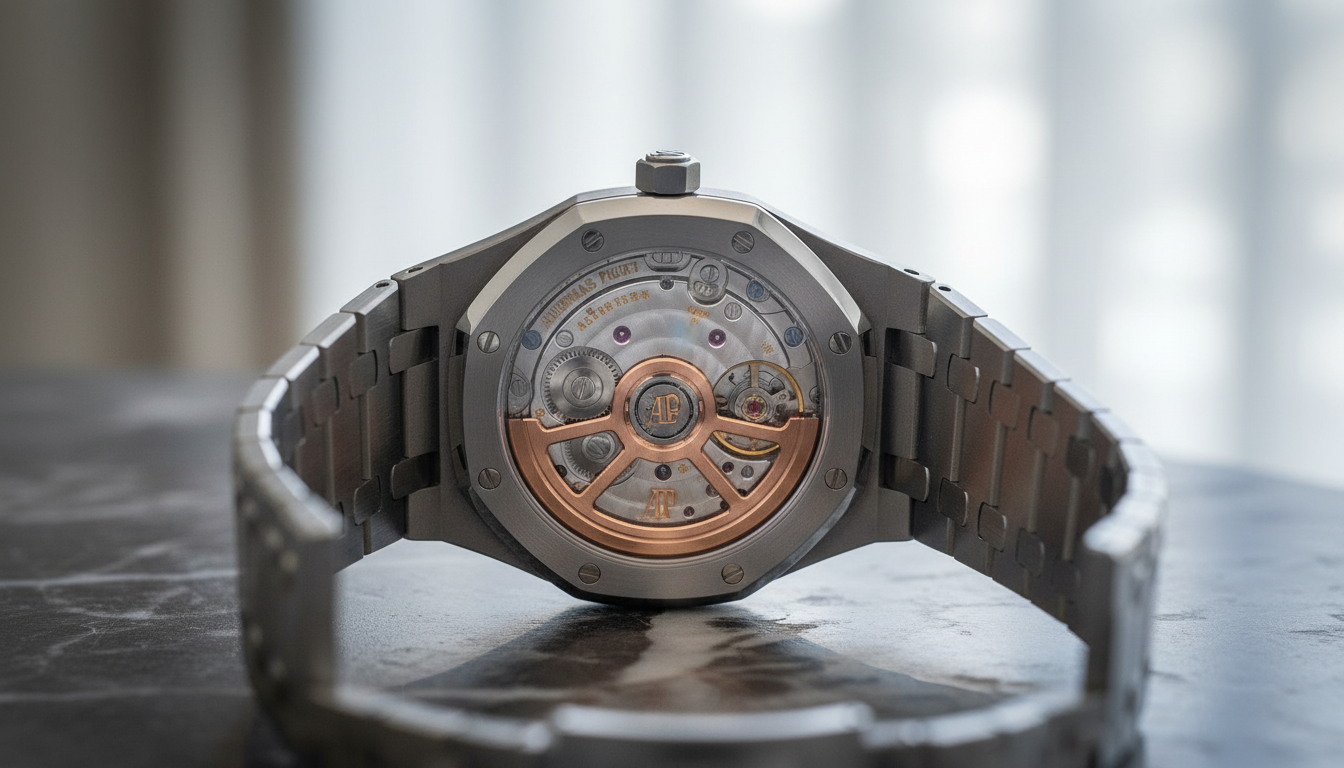
For fifty years, the "Jumbo" was powered by the legendary Calibre 2121, itself an engineering marvel. The reference 16202, introduced for the model's 50th anniversary, houses a new engine: the Calibre 7121. Visible through the sapphire caseback, it represents a significant, if subtle, evolution. The first change one notices is the dedicated 22-carat gold rotor, skeletonised and bearing the "50 Years" anniversary emblem on the models from that year.
Functionally, it brings the "Jumbo" into the modern era with a quick-set date—a small but profound convenience for the wearer—and a power reserve extended to 55 hours. The balance wheel beats at a higher frequency of 4Hz (28,800 vph), promising greater chronometric stability. Yet despite these upgrades, the movement remains impressively slim, allowing the 16202 to retain the iconic "Extra-Thin" profile of its predecessors. It is a respectful evolution, a passing of the torch that honours the past while embracing the present.
Handing the watch back across the tray, its absence was immediately felt. The Royal Oak is not a subtle watch, but its power is not one of brute force. It is the power of a perfectly realised idea. It challenged the conventions of its time and, in doing so, became a timeless object, a piece of audacious design that continues to define the very concept of a modern classic.