The Mille Miglia at Moniga del Garda
A thousand miles of pre-war Italy rolled past our lakeside village yesterday afternoon — and the whole town stepped out to meet it.
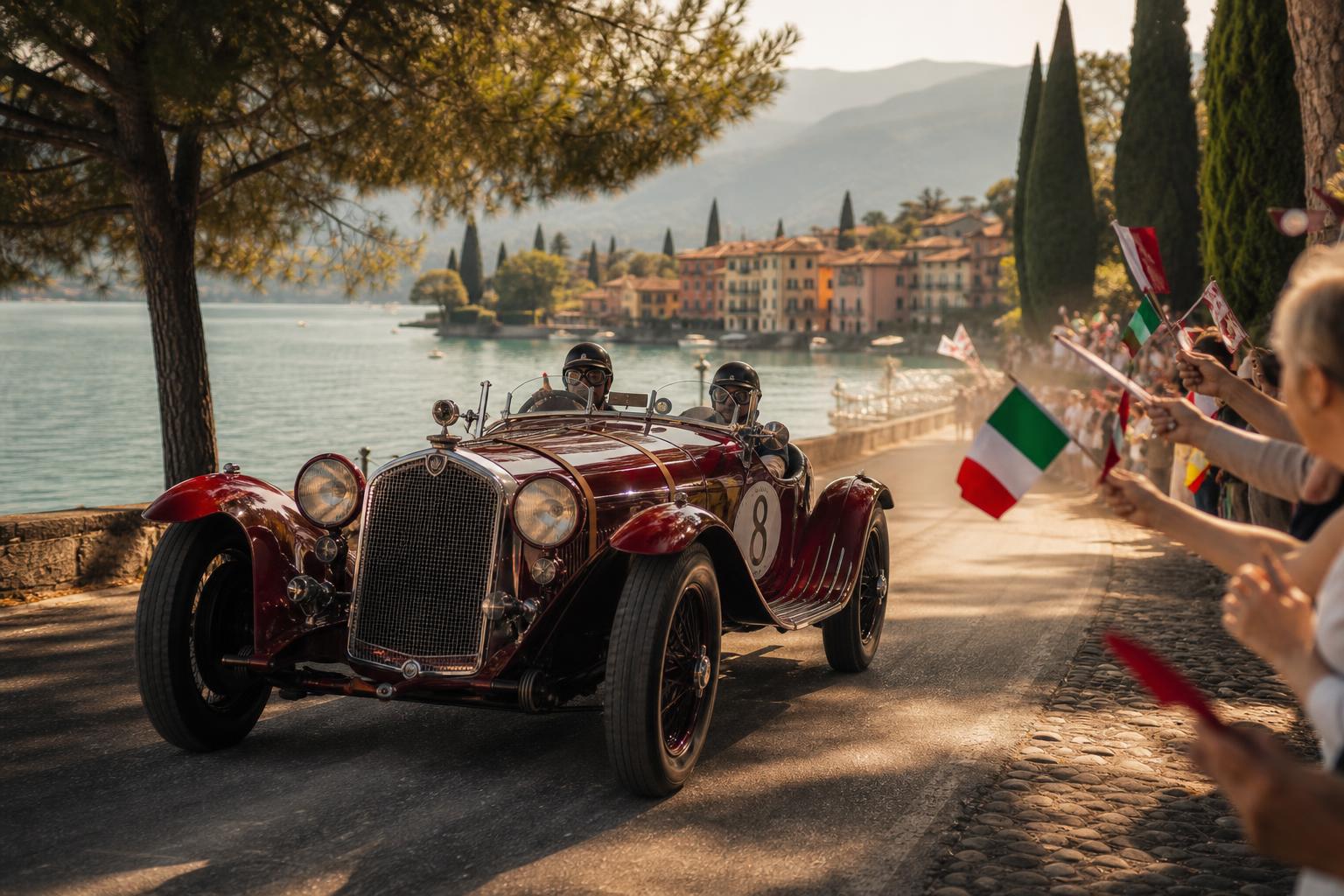
Yesterday, I stood on the lakeside at Moniga del Garda and watched the better part of a century of motoring history rumble past in single file. The Mille Miglia had reached Lake Garda, and the road through our quiet little town had been quietly transformed into a moving museum — open to the sky, scored by twelve cylinders, lined with children waving tricolour flags.
There is something deeply Italian about the way a place like Moniga absorbs an event like this. No grandstands. No pageantry imported from elsewhere. Just a stretch of lake road under the pines, a gelateria still open, and a couple of carabinieri leaning against a wall, smiling at the noise. Then the cars arrive — Alfas, Lancias, OMs, the occasional pre-war Bugatti — and the whole village steps forward as one.
A race born of wounded pride
The Mille Miglia was born in 1927, in the wake of a small civic insult. Brescia, which had hosted the Italian Grand Prix in 1921, lost the race to Monza three years later. A handful of local aristocrats and industrialists — Aymo Maggi, Franco Mazzotti, Giovanni Canestrini and Renzo Castagneto, the so-called quattro moschettieri — decided Brescia would answer with something the purpose-built circuits could never match: a thousand miles of open Italian road, from Brescia to Rome and back, run on the public highway, through villages and over mountain passes, in a single ferocious push.
The name was literal. Mille miglia — a thousand Roman miles — traced a rough figure of eight down the spine of the country and back. The first edition, in March 1927, was won by Ferdinando Minoia and Giuseppe Morandi in an OM 665 averaging just under 78 km/h. It was an event without precedent: not a Grand Prix, not a rally, but something stranger and more romantic — a road race that took the whole of Italy as its track.
For the next three decades it became the most coveted prize in motorsport. Nuvolari won it. Caracciola won it, the only non-Italian to do so before the war. Stirling Moss and Denis Jenkinson's 1955 victory in the 300 SLR — averaging just shy of 160 km/h for ten and a half hours, with Jenkinson reading pace notes from a rolling toilet roll — remains, by some quiet consensus, the greatest single drive in motoring history.
The end, and the second life
It could not last. By 1957 the cars had simply outgrown the roads. That year, the Marquis de Portago's Ferrari blew a tyre near Guidizzolo, and the resulting crash killed him, his co-driver, and nine spectators including five children. The Italian state shut the race down. The original Mille Miglia — twenty-four editions across thirty years — was finished.
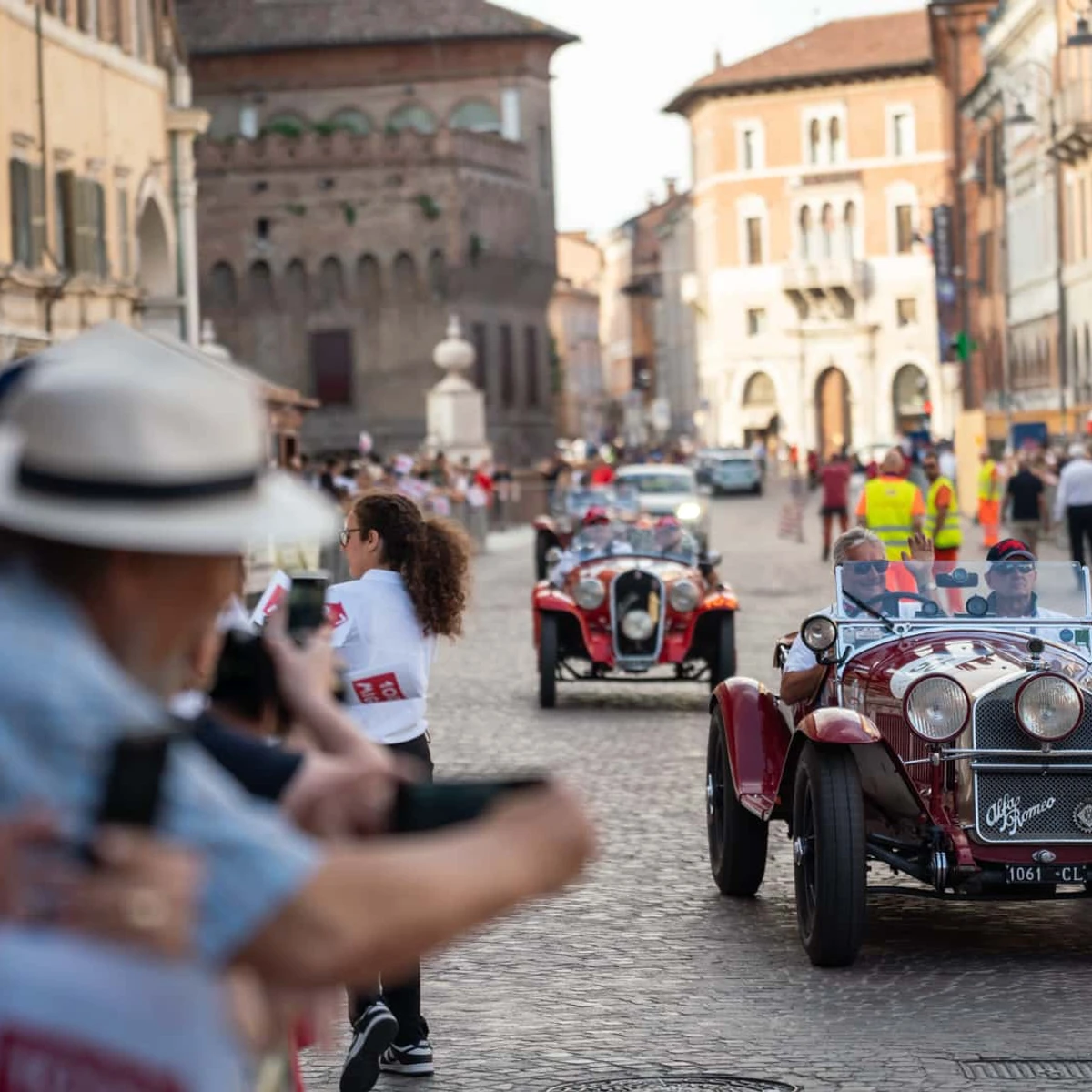
What survives today is the Mille Miglia Storica, revived in 1977 as a regularity rally for cars built before 1957, the cut-off being the year of the original race's death. It is no longer about outright speed. It is about preservation — of the cars, of the route, of a certain idea of what it once meant to drive across Italy in May, with the windows down and the mountains ahead. To enter, your car must be a model that competed, or could have competed, in the original race. The roll call reads like an inventory of pre-war engineering: Alfa Romeo 6C and 8C, Lancia Aprilia and Aurelia, OM 665, Bugatti Type 35, Ferrari 166 MM, Mercedes 300 SL, Jaguar XK120.
Moniga, in the late afternoon
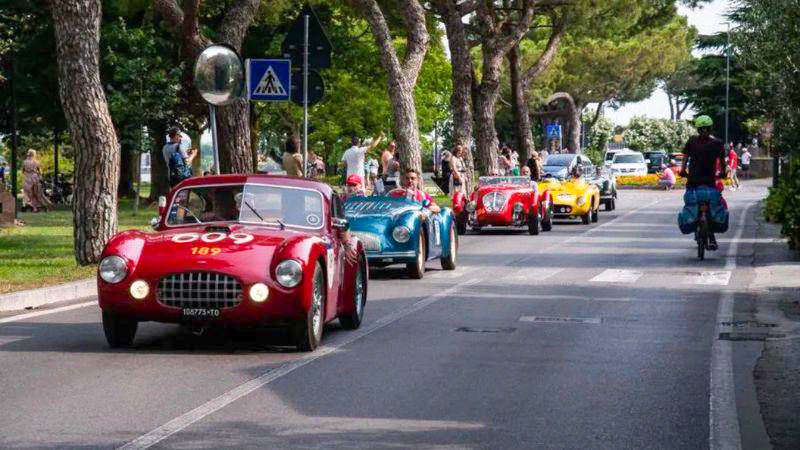
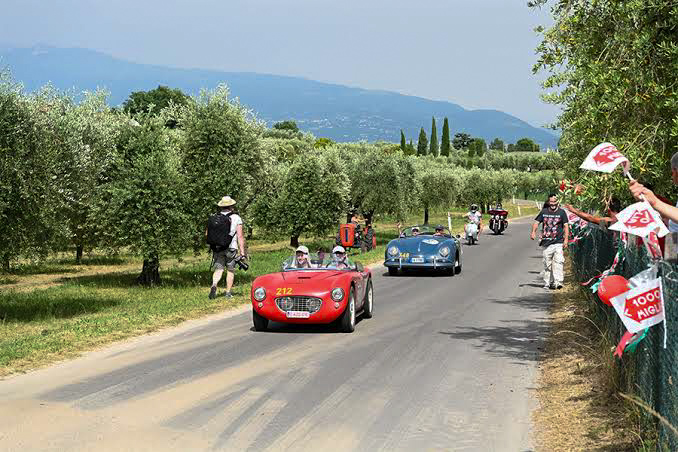
The peloton came through in waves. First a low red Alfa with the number 189 painted on the bonnet, headlights on in the dappled shade of the pines, the driver waving with one hand and steering with the other. Behind it, a blue Triumph, then a yellow Healey, then something I could not place — pre-war, narrow, hammered aluminium body riveted at the seams, the bonnet straps catching the light.
For about an hour, the lake road belonged to them. Cyclists pulled over. Café tables filled. An old man next to me, perhaps eighty, watched without speaking, and at one point simply removed his hat. I think that gesture said more about what the Mille Miglia means here than anything I could write.
If you would like to see how it actually looked and sounded yesterday — the cars rolling past, the village, the lake behind — I posted a short film on Instagram. You can find it on The Continental Man on Instagram. Worth thirty seconds of your day.
Why it still matters
There are faster races. There are more important ones in any sporting sense. But the Mille Miglia is the only one I can think of that genuinely belongs to the country it runs through. It is not a circuit closed to the public. It is the public — the village squares, the lakeside roads, the small towns of Emilia and Tuscany and the Veneto — pressed into service for a few days each spring as a stage for the most beautiful machines ever built.
Enzo Ferrari called it la corsa più bella del mondo — the most beautiful race in the world. He was not given to sentimentality, and he was right. Watching it pass through Moniga yesterday, with the lake catching the late light and the smell of warm castor oil hanging over the road, it was difficult to disagree.