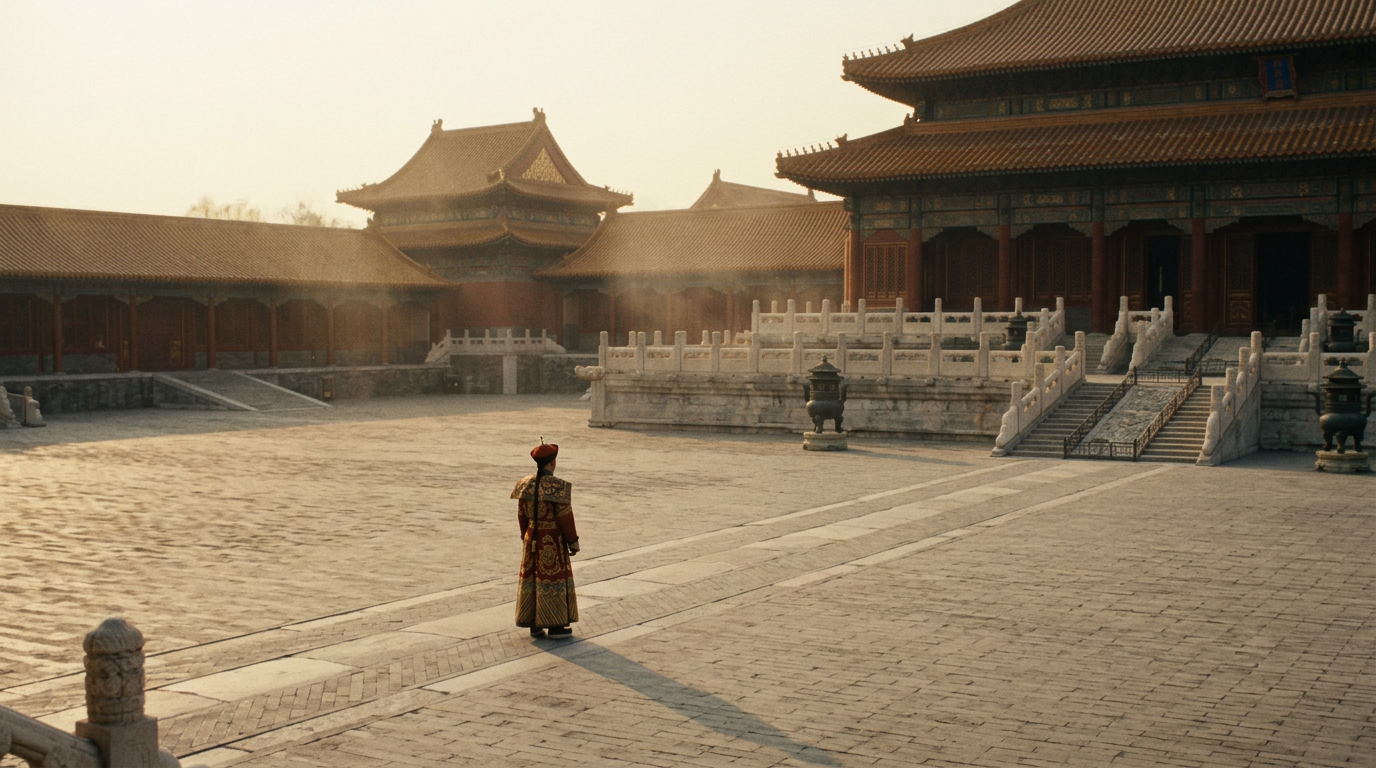
Original interpretation — not a still from the production
Bernardo Bertolucci’s epic chronicle of Pu Yi, China’s last emperor, presents a life shaped by ritual and the inexorable march of history, all rendered with an unparalleled visual grandeur.
The Continental Verdict
Essential
Bernardo Bertolucci’s 1987 masterpiece, "The Last Emperor", remains a towering achievement in cinematic storytelling, offering a meticulous and often poignant examination of a life inextricably bound to the fate of a nation. Following the trajectory of Aisin-Gioro Pu Yi from his enthronement as a child emperor, through his internment, and ultimately to his life as a gardener in the People’s Republic, the film is a sweeping historical tableau. It is a narrative less about a singular man and more about the crushing weight of history and ceremony, of a boy king stripped of power, then status, yet never quite shedding the mantle of his imperial past. The grandeur of the Forbidden City, where much of the early narrative unfolds, is not merely a backdrop but a character in itself – a gilded cage that offers immense privilege at the cost of true freedom.
What elevates "The Last Emperor" beyond a mere historical retelling is Bertolucci’s audacious visual ambition, realised by Vittorio Storaro’s breathtaking cinematography. Each frame is composed with the precision of a classical painting, drenched in rich colour and symbolism, transforming the Forbidden City into a living, breathing entity. The film’s narrative breadth, spanning half a century of Chinese upheaval, is matched by its intimate focus on Pu Yi’s internal struggles. It delves into the isolation of absolute power, the disorientation of political transition, and the quiet dignity of a man learning to navigate a world that has utterly transformed around him. It is a film that demands immersion, rewarding the discerning viewer with a profound reflection on identity, legacy, and the relentless currents of change.
Why Watch It
The Gentleman Factor
The gentleman may observe the profound burden of inherited duty, the inevitable decline of anachronistic institutions, and the quiet resilience required to adapt to a world profoundly altered, all whilst appreciating the finest cinematic artistry.
Look Out For
- Widescreen epic
- Lush colour palette
- Imperial Chinese architecture
The Locations
The Forbidden City, Beijing; Changchun, Manchuria; The Forbidden City, Dalian, Jilin Province, China (for certain interiors); Cinecittà Studios, Rome (for some interior sets).
More from the travel pages →The Cars
Period motorcars appropriate to the 1920s and 30s, including some luxurious European models used by Pu Yi during his time as Emperor of Manchukuo.
More from motoring →The Wardrobe
The resplendent imperial robes and court attire of the Qing Dynasty, transitioning to Western suits and military uniforms of the 1920s and 30s, and finally, the humble attire of a Chinese citizen in the Maoist era. Designed by James Acheson and Franco Zeffirelli.
More on style →The Soundtrack
A haunting and evocative score by Ryuichi Sakamoto, David Byrne, and Cong Su, blending traditional Chinese instruments with Western orchestral and synthesised elements.
Into the music room →Watch Next
Where to Watch
Available on physical media (Blu-ray, DVD) and select digital rental/purchase platforms.
For the Collection
Also in The Gentleman's Canon
As an Amazon Associate I earn from qualifying purchases. Links cost you nothing and never influence what we recommend. Recommendations are honest and never paid for. Imagery is an original interpretation, not a still from the production.