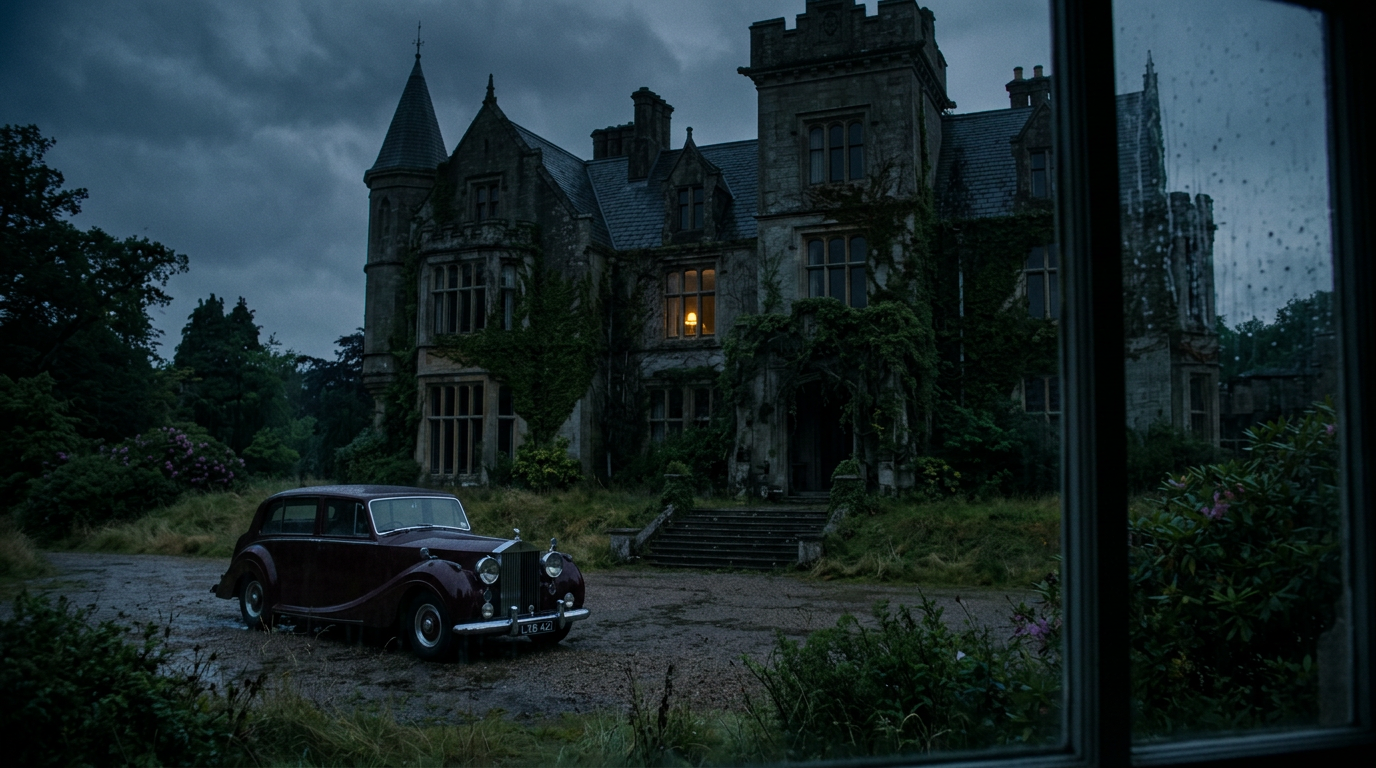
Original interpretation — not a still from the production
A cautionary tale of Hollywood illusion and delusion, narrated by a man already lost to its machinations.
The Continental Verdict
Essential
Billy Wilder’s masterpiece, "Sunset Boulevard," remains as chillingly potent today as it was upon its release in 1950. The film opens with the unforgettable image of a body floating face down in a swimming pool, and from this macabre beginning, we are drawn into the tragic orbit of Norma Desmond, a forgotten silent film star, and Joe Gillis, a struggling screenwriter. Wilder, ever the master of cynical wit, paints a devastating portrait of ambition, delusion, and the unforgiving nature of fame. Gloria Swanson delivers a monumental performance as Desmond, a woman trapped in a gilded cage of her own making, meticulously preserved by her devoted butler and former husband, Max von Mayerling, played with haunting gravitas by Erich von Stroheim.
The genius of "Sunset Boulevard" lies not only in its sharp script, co-written by Wilder, Charles Brackett, and D.M. Marshman Jr., but also in its audacious narrative structure, told through the sardonic voice of its deceased protagonist. The film is a brutal dissection of the Hollywood dream factory, a place where legends are made and discarded with equal ruthlessness. It explores themes of youth exploited, talent withered, and the desperate lengths to which individuals will go to cling to a fleeting past. The opulent yet decaying mansion, designed by Hans Dreier and John Meehan, becomes a character in itself, a mausoleum to Norma’s bygone era, while Franz Waxman’s score brilliantly underscores the rising tension and ultimate tragedy. This is not merely a film; it is a profound commentary on the cost of illusion.
Why Watch It
The Gentleman Factor
The gentleman observes the pitfalls of clinging to past glories, the dangers of unbridled delusion, and the true cost of artistic compromise. It teaches a valuable lesson in recognising when one’s time has passed, or when an ambition is ill-fated, rather than descending into a grotesque charade.
Look Out For
- Classic Hollywood glamour
- Gothic decay
- Sartorial precision
The Locations
The iconic Norma Desmond mansion (interiors at Paramount Studios, exterior at 3801 Wilshire Boulevard, and 641 S. Irving Boulevard), Schwab's Pharmacy, Paramount Studios lots and offices, Beverly Hills.
More from the travel pages →The Cars
Joe Gillis's 1946 Plymouth Special Deluxe convertible; Norma Desmond's custom-built 1929 Isotta Fraschini Tipo 8A Castagna landaulet.
More from motoring →The Wardrobe
Edith Head’s costumes for Norma Desmond are legendary: lavish robes, ornate headpieces, dark glasses, and a general air of theatrical excess that perfectly communicates her character's arrested development. Joe Gillis, conversely, wears simple, worn suits and casual attire, reflecting his struggling status. Max von Mayerling is always immaculately attired in a butler's uniform, or formal wear, denoting his unwavering devotion and the mansion's continued adherence to a bygone standard.
More on style →The Soundtrack
Franz Waxman's score is a towering achievement, rich with operatic grandeur and noirish tension. The "Norma Desmond" theme is particularly haunting, evoking both her former glory and her current instability. The use of tango music for her dances with Joe is also notable.
Into the music room →Watch Next
Where to Watch
Available on physical media (Blu-ray, DVD) and streaming platforms that offer classic cinema catalogues.
For the Collection
Also in The Gentleman's Canon
As an Amazon Associate I earn from qualifying purchases. Links cost you nothing and never influence what we recommend. Recommendations are honest and never paid for. Imagery is an original interpretation, not a still from the production.