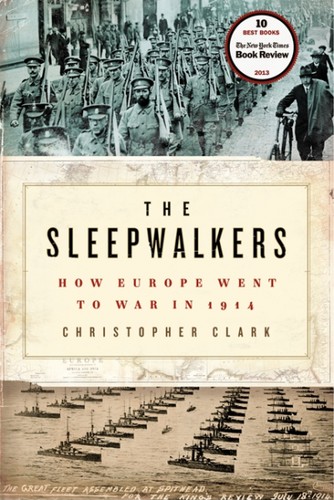
Publisher edition artwork
The Sleepwalkers
Christopher Clark · First published 2012
A masterly investigation into the diplomatic blunders and personal failings that ignited the Great War
Essential
Demanding · 888 pages (Penguin Press hardcover)
Why Read It?
To comprehend the nuanced and multifaceted causes of the First World War, moving beyond simplistic narratives of blame.
What It's About
A detailed analysis of the diplomatic events, political climate, and key figures across Europe that collectively led to the outbreak of the First World War in 1914.
Why It Matters
It offers a critical re-evaluation of one of history's most pivotal conflicts, highlighting the dangers of systemic failure and political miscalculation, and providing insights into how geopolitical tensions can escalate into global catastrophe.
The Review
Christopher Clark’s "The Sleepwalkers: How Europe Went to War in 1914" stands as a monumental work of historical scholarship, dismantling long-held assumptions about the origins of the First World War. Published in 2012, it arrived at a pivotal moment, on the cusp of the centenary of the conflict, offering a fresh, meticulously researched perspective that moved beyond the traditional focus on German culpability. Clark’s central thesis is that no single nation or individual was solely responsible; instead, a complex interplay of miscalculation, systemic failures, and a collective inability to de-escalate led Europe’s leaders, like sleepwalkers, into the abyss.
Clark’s narrative is forensic, delving into the intricate web of alliances, diplomatic communications, and the personal convictions of key figures across the continent. He meticulously traces the sequence of events from the assassination of Archduke Franz Ferdinand in Sarajevo through the July Crisis, illuminating the incremental steps and missed opportunities for peace. The book excels in its multi-archival research, drawing on sources from Vienna, Belgrade, Berlin, Paris, St. Petersburg, and London to construct a truly pan-European account. Rather than assigning blame, Clark reveals a world of competing ambitions, entrenched nationalisms, and a pervasive sense of fatalism that ultimately propelled Europe towards catastrophe.
The prose is lucid and engaging, despite the complexity of the subject matter, making it accessible to both specialists and the general reader. Clark’s ability to weave together disparate threads into a coherent and compelling narrative is a testament to his skill as a historian. "The Sleepwalkers" is not merely a recounting of events; it is a profound exploration of human agency and structural forces, reminding us that even the most well-intentioned leaders can, through a series of flawed decisions and perceptions, stumble into unimaginable conflict. It reshaped the discourse around 1914 and remains an indispensable work for understanding the profound tragedy of the First World War.
Best Read
In a quiet study with a map of pre-war Europe at hand, preferably in the darker months.
Three Things You'll Take From It
- 01
The First World War was not the result of a single nation's aggression, but a collective failure of statesmanship and diplomacy.
- 02
The intricate web of alliances and national interests created a brittle system prone to escalation.
- 03
Individual personalities and their perceptions played a crucial role in decision-making during the July Crisis.
Better Read or Heard?
The audiobook, narrated by Gildart Jackson, is a well-produced rendition, maintaining the gravity and detail of the text without sacrificing clarity. Its length, however, necessitates a dedicated listening commitment.
If You Like This…
July 1914: Countdown to War — Sean McMeekin
A complementary, somewhat contrarian perspective, focusing on Russian and French roles.
Find it on AmazonThe War That Ended Peace: The Road to 1914 — Margaret MacMillan
A broader cultural and political history leading up to the war.
Find it on Amazon
The Edition to Own
The Penguin Press hardcover edition (2012) is robust and well-bound, ideal for repeated consultation. For portability, the Penguin paperback (2013) is excellent, featuring clear typography and comprehensive maps.
As an Amazon Associate I earn from qualifying purchases. Links cost you nothing and never influence what we recommend.