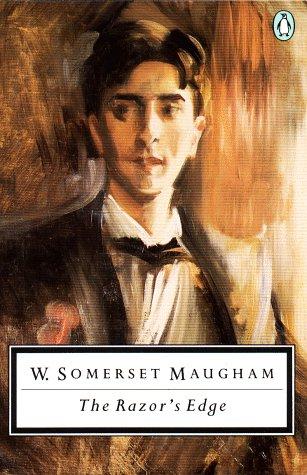
Publisher edition artwork
The Razor's Edge
W. Somerset Maugham · First published 1944
A young American abandons his privileged life to seek profound meaning in a world scarred by war
Essential
Moderate · 352 pages
Why Read It?
To accompany a contemplative spirit on a journey beyond the material, exploring the deeper questions of human existence and the pursuit of meaning.
What It's About
The novel follows Larry Darrell, an American World War I veteran, as he forsakes wealth and societal expectations to embark on a spiritual quest across Europe and India, much to the consternation of his social circle, particularly his fiancée Isabel.
Why It Matters
It offers a powerful narrative exploring themes of existential purpose, the emptiness of materialism, and the diverse paths individuals take in their search for enlightenment and peace, all framed within the elegant prose of a master storyteller.
The Review
Published in 1944, W. Somerset Maugham’s *The Razor’s Edge* stands apart from much of his oeuvre, trading the cynical observations of his earlier works for a profound, if subtly rendered, spiritual quest. It is the story of Larry Darrell, a young American aviator traumatised by his experiences in the First World War, who rejects the conventional path of wealth and social expectation in Chicago. His fiancée, Isabel, and their glittering circle struggle to comprehend his desire for philosophical enlightenment over material comfort. Maugham, who inserts himself into the narrative as a semi-fictional observer, crafts a compelling portrait of post-war disillusionment and the search for transcendent truth.
Larry’s journey takes him from Paris to a Benedictine monastery, through coal mines in Germany, and ultimately to India, where he studies under a revered guru. Maugham’s prose, always elegant and precise, here serves to illuminate complex philosophical questions without becoming didactic. He presents a gallery of memorable characters—the worldly and pragmatic Isabel, the dissolute but charming Elliott Templeton, and the tragically flawed Sophie Macdonald—each grappling with their own forms of contentment or despair. The novel deftly explores themes of self-discovery, renunciation, and the elusive nature of happiness, culminating in a vision of life where conventional success holds little sway against the deep peace found in spiritual awakening. It remains Maugham's most quietly subversive work, gently challenging the reader to consider what truly constitutes a life well-lived.
Best Read
In a quiet study, perhaps with a view of autumn leaves, or during an extended journey requiring deep introspection.
Three Things You'll Take From It
- 01
The courage to forge one’s own path, even when it defies social norms.
- 02
Material wealth rarely equates to genuine contentment.
- 03
The profound impact of trauma on shaping one’s life philosophy.
Better Read or Heard?
The audiobook narrated by Robert Whitfield (available via Audible) offers a measured and fitting interpretation of Maugham's prose and characters, suitable for extended listening.
If You Like This…
Siddhartha — Hermann Hesse
For its exploration of a spiritual journey and self-discovery in an Eastern context.
Find it on AmazonOf Human Bondage — W. Somerset Maugham
For a broader understanding of Maugham’s development and philosophical introspection, though more overtly autobiographical.
Find it on Amazon
The Edition to Own
The Vintage Books paperback edition (ISBN 978-0-679-72314-2) is a readily available and well-presented volume, offering clear typeface and a reasonable price point for this classic.
As an Amazon Associate I earn from qualifying purchases. Links cost you nothing and never influence what we recommend.