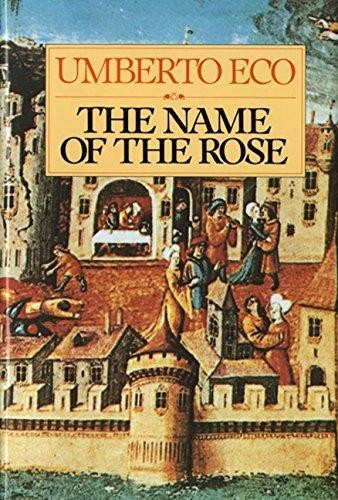
Publisher edition artwork
The Name of the Rose
Umberto Eco · First published 1980
Amidst the arcane splendour of a medieval abbey, a Franciscan friar unravels a complex web of murders and forbidden knowledge
Essential
Demanding · Approximately 500 pages, depending on edition
Why Read It?
To experience a rare confluence of high intellectual adventure, historical immersion, and a gripping murder mystery that transcends the genre.
What It's About
A 14th-century Franciscan friar, William of Baskerville, and his novice, Adso, investigate a series of mysterious deaths in a secluded Benedictine monastery, uncovering a conspiracy tied to forbidden books and theological disputes.
Why It Matters
It masterfully blends historical fiction, detective narrative, and philosophical inquiry, offering a profound exploration of knowledge, faith, and the interpretation of signs, while remaining a compelling story.
The Review
Umberto Eco's 1980 debut novel, originally published in Italian as "Il nome della rosa", established him not merely as a distinguished semiotician but as a master storyteller. Set in a Benedictine monastery in northern Italy in 1327, the narrative unfolds through the eyes of Adso of Melk, a young novice accompanying the sagacious Franciscan friar William of Baskerville. Their arrival coincides with a series of perplexing deaths, initially dismissed as divine retribution or accident, but soon revealed to be the work of a cunning, erudite killer within the abbey's walls. The intellectual rigour Eco applies to the setting and the period is formidable, creating an immersive historical tapestry that feels both alien and acutely observed.
The novel is far more than a simple whodunit; it is a profound meditation on heresy, faith, the nature of truth, and the power of knowledge, particularly the role of books and libraries in shaping human understanding. William of Baskerville, a character often noted for his resemblance to Sherlock Holmes, employs a rigorous logic rooted in scholasticism and empiricism to decipher clues that range from coded manuscripts to labyrinthine architecture. The initial pages, dense with theological and philosophical discourse, demand patience, yet reward the assiduous reader with a narrative that deepens in complexity and suspense, culminating in a dramatic confrontation within the abbey's forbidden library. Eco's erudition is never ostentatious; rather, it serves to enrich a compelling story.
Best Read
In a quiet study, perhaps with a cup of strong tea, allowing ample time for its intricate details to unfold.
Three Things You'll Take From It
- 01
The profound power and danger of knowledge, particularly when restricted or misinterpreted.
- 02
The tension between faith and reason in medieval thought, and its echoes in contemporary intellectual life.
- 03
The art of deduction and semiotics as tools for understanding complex realities.
Better Read or Heard?
Sean Barrett’s narration of the audiobook is highly regarded, capturing the novel's intellectual gravity and narrative tension with suitable gravitas.
If You Like This…
Foucault's Pendulum — Umberto Eco
Another intricate, erudite puzzle from Eco, though even more demanding.
Find it on AmazonThe Name of Annabel Lee — Lenore Hart
A gothic mystery with a literary bent, evoking a similar sense of arcane pursuit.
Find it on Amazon
The Edition to Own
The current Picador Modern Classics paperback, translated by William Weaver, is widely accessible and respects the original’s intellectual texture. For a more substantial edition, look for the Harcourt hardcover from the 1980s.
As an Amazon Associate I earn from qualifying purchases. Links cost you nothing and never influence what we recommend.