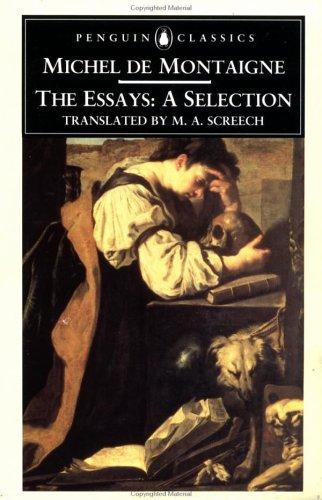
Publisher edition artwork
The Essays
Michel de Montaigne · First published 1580
Michel de Montaigne invented the essay as a form, offering a candid exploration of the human condition that remains profoundly relevant
Essential
Moderate · Very long
Why Read It?
To encounter the progenitor of modern self-reflection, whose insights into human nature remain as fresh and pertinent today as they were over four centuries ago.
What It's About
A sprawling collection of personal reflections, observations, and philosophical enquiries, covering a vast range of subjects from the trivial to the profound, all filtered through Montaigne's uniquely introspective and candid perspective.
Why It Matters
Montaigne pioneered a literary form, the essay, and a mode of intellectual inquiry that prioritised individual experience and reasoned doubt. His work laid groundwork for Enlightenment thought and continues to influence writers and thinkers who value introspection, critical thinking, and the pursuit of self-knowledge.
The Review
Michel de Montaigne, a Gascon nobleman of the 16th century, retreated to his tower library to write, creating a new literary form that continues to resonate. His 'Essays', first published in 1580, are a vast, meandering conversation with himself, and by extension, with the reader. He explores everything from customs and education to death and friendship, always circling back to the central subject: himself. Yet, this introspection is never self-indulgent; rather, it serves as a vehicle for understanding the universal human experience. Montaigne's genius lies in his intellectual honesty, his willingness to question received wisdom, and his delightful ability to contradict himself with good humour.
His method was revolutionary. Unlike the scholastic treatises of his era, Montaigne’s writing is intimate, discursive, and remarkably modern. He quotes liberally from classical authors, not to display erudition, but to engage in a dialogue across centuries, filtering ancient wisdom through his own lived experience. The charm of the 'Essays' lies in this personal voice – hesitant, curious, and profoundly human. He eschews grand pronouncements in favour of gentle enquiry, inviting the reader to join him in the pursuit of self-knowledge. This remarkable body of work is not merely a historical curiosity but a vital companion for anyone seeking a deeper understanding of themselves and the world.
Best Read
Ideally, in a quiet study, over several months or years, dipping in and out as the mood strikes.
Three Things You'll Take From It
- 01
The art of living is found in honest self-observation.
- 02
Scepticism and intellectual humility are virtues.
- 03
The human condition is a tapestry of contradictions.
Better Read or Heard?
Audiobook versions exist, but the "Essays" truly demand to be read at one's own pace, allowing for rumination and re-reading. Not ideal for a quick listen.
If You Like This…
Meditations — Marcus Aurelius
Another profound journey into self-examination, though more Stoic in its discipline.
Find it on AmazonThe Pillow Book — Sei Shōnagon
A collection of personal observations and musings from a Heian court lady, offering a distinct cultural counterpoint.
Find it on Amazon
The Edition to Own
The most celebrated and enduring English translation is by M.A. Screech, published by Penguin Classics. Available in both paperback and a handsome hardcover.
As an Amazon Associate I earn from qualifying purchases. Links cost you nothing and never influence what we recommend.