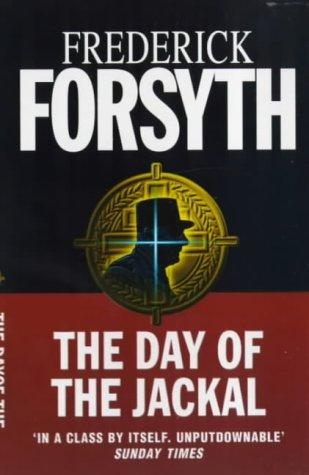
Publisher edition artwork
The Day of the Jackal
Frederick Forsyth · First published 1971
You know the ending, yet you will still not put it down
Essential
Moderate · 384 pages (approx.)
Why Read It?
To experience a procedural thriller of unparalleled precision and immerse yourself in a meticulously researched plot that defined a genre.
What It's About
A professional assassin, known only as 'The Jackal', is hired by the disgruntled Organisation armée secrète (OAS) to assassinate French President Charles de Gaulle. The novel follows his meticulous preparations and the equally determined efforts of French intelligence and police, led by Deputy Commissioner Claude Lebel, to identify and stop him before he can strike.
Why It Matters
It established the 'procedural thriller' as a distinct and highly influential genre, demonstrating that suspense can be derived from detailed operational accuracy rather than mere plot twists. It influenced countless authors and filmmakers, setting a high bar for authenticity in espionage fiction.
The Review
Frederick Forsyth’s 1971 debut, *The Day of the Jackal*, is a masterclass in procedural suspense, a meticulous chronicle of an assassination plot against Charles de Gaulle. Forsyth, a former Royal Air Force pilot and journalist, brings a reporter’s unflinching eye for detail and a strategist’s precision to his narrative, constructing a story that feels less like fiction and more like a historical recounting of a very plausible, albeit failed, enterprise. The novel’s genius lies not in *what* happens – the outcome is revealed in the opening pages – but in *how* it happens. Every step, from the commissioning of the assassin by the disgruntled OAS to the intricate planning of the killing, is laid bare with an almost forensic intensity.
The dual narrative, tracking the enigmatic 'Jackal' as he moves across Europe assuming various identities and assembling his tools, and the dogged pursuit by Deputy Commissioner Claude Lebel of the Sûreté Nationale, creates a relentless tension. Lebel, an unassuming but brilliant detective, becomes the reader’s anchor in the labyrinthine world of French bureaucracy and international intelligence. Forsyth avoids histrionics, opting instead for a cool, detached tone that amplifies the chilling professionalism of both predator and prey. The novel eschews grand pronouncements or moralising, presenting instead a stark, unvarnished portrait of political extremism and the dedicated public service required to counter it. It remains a benchmark for the genre, demonstrating that true suspense derives not from mystery but from inevitability, precisely observed. It is a work that rewards re-reading, revealing new layers of its intricate mechanism with each pass.
Forsyth's command of operational minutiae — from forging passports to sourcing a custom-made rifle — is staggering, lending the narrative an unimpeachable authenticity. This meticulousness, which might in lesser hands become tedious, here serves to heighten the sense of verisimilitude, convincing the reader that such an event *could* have happened. The characters, though largely defined by their roles in the unfolding drama, possess just enough psychological depth to make their motivations credible. The Jackal, for instance, is not a caricature of evil but a cold professional, driven by a mercenary’s code. Lebel, in contrast, is a study in quiet, understated competence, a man whose intellectual rigour is his greatest weapon. The novel’s enduring appeal lies in its rigorous dedication to process, its elegant structure, and its refusal to compromise on the harsh realities of its subject matter. It is an exemplary piece of craftsmanship, demonstrating the power of a well-told story rooted in rigorous research.
Best Read
On a long-haul flight, perhaps between Paris and Nice, ideally with a substantial French red wine.
Three Things You'll Take From It
- 01
The most compelling suspense can come from knowing the outcome but not the journey.
- 02
Meticulous planning and research are crucial elements of effective storytelling.
- 03
Competence, whether for good or ill, is inherently fascinating to observe.
Better Read or Heard?
The audiobook, often read by a British narrator, benefits from the precise and measured prose, lending itself well to a slow, immersive listen.
If You Like This…
The Odessa File — Frederick Forsyth
Another Forsyth classic exploring post-war Nazi hunting.
Find it on AmazonEye of the Needle — Ken Follett
A WWII spy thriller known for its tense cat-and-mouse game.
Find it on Amazon
The Edition to Own
The first edition published by Hutchinson in 1971 in hardcover remains a collector's item. For a contemporary reading, any reputable paperback or hardcover edition is suitable; however, the Folio Society occasionally produces finely bound editions of such classics, which are always recommended for the discerning reader.
As an Amazon Associate I earn from qualifying purchases. Links cost you nothing and never influence what we recommend.