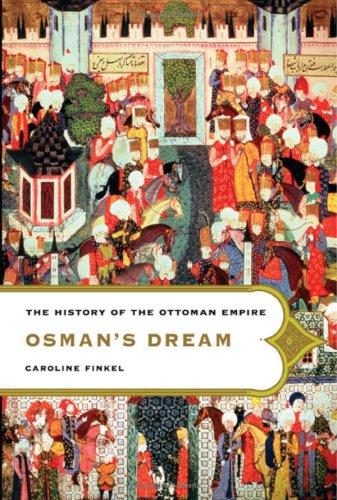
Publisher edition artwork
Osman's Dream
Caroline Finkel · First published 2005
An authoritative and engaging history of the Ottoman Empire, spanning six centuries of its formidable power
Highly Recommended
Moderate · 660 pages
Why Read It?
To gain a comprehensive, authoritative, and non-clichéd understanding of the Ottoman Empire before visiting Istanbul or other former Ottoman lands.
What It's About
The six-century history of the Ottoman Empire, from its founding by Osman I to its dissolution after World War I, covering its political, social, cultural, and military evolution.
Why It Matters
It offers a vital corrective to often-simplistic Western narratives about the Ottomans, revealing their profound impact on European and Middle Eastern history and highlighting the enduring cultural and political legacies that resonate today.
The Review
Caroline Finkel's *Osman's Dream* offers a panoramic sweep of the Ottoman Empire, from its humble Anatolian origins in the late 13th century to its dissolution in the early 20th century. Finkel, a scholar with a deep understanding of Turkish history and culture, eschews romanticism and facile generalisations in favour of meticulous research and a clear, elegant narrative. The book is structured chronologically, detailing the reigns of sultans, the expansion and contraction of borders, and the intricate social and political machinations that defined one of history's longest-lived empires. Rather than merely recounting battles and treaties, Finkel delves into the daily life, artistic achievements, and administrative innovations that underpinned Ottoman longevity, presenting a nuanced portrayal that challenges many Western preconceptions.
What sets *Osman's Dream* apart is its commitment to presenting a truly Ottoman perspective. Finkel draws extensively on primary sources, many translated anew, to allow the voices of Ottoman chroniclers, poets, and statesmen to emerge. This approach lends an authenticity and depth often missing in histories written from an external viewpoint. The prose, while scholarly, remains accessible and engaging, making complex historical processes understandable without ever oversimplifying. Readers will find themselves immersed in the world of Janissaries, viziers, and the opulent courts of Topkapi Palace, gaining a profound appreciation for the sophistication and enduring legacy of this formidable imperial power. It is a work that demands attention but richly rewards it.
Best Read
Best read at a spacious desk, perhaps with a strong Turkish coffee, taking one
Three Things You'll Take From It
- 01
The Ottoman Empire was a sophisticated, adaptable, and remarkably long-lived entity, not merely a static "sick man of Europe."
- 02
Its success stemmed from a unique synthesis of Islamic, Turkic, and Byzantine influences, creating a distinct imperial culture.
- 03
The decline of the empire was a complex, protracted process influenced by internal dynamics and external pressures, rather than a sudden collapse.
Better Read or Heard?
No particularly distinguished audiobook adaptation is noted, but the narrative is sufficiently compelling to carry a standard reading.
If You Like This…
Lords of the Horizons — Jason Goodwin
A more anecdotal and travel-focused account of Ottoman history.
Find it on AmazonIstanbul: A Tale of Three Cities — Bettany Hughes
Explores the rich history of Constantinople/Istanbul through its various epochs.
Find it on Amazon
The Edition to Own
The 2005 Basic Books hardcover edition (ISBN: 978-0465023907) is robust and well-bound, ideal for extended study. A more readily available paperback is published by John Murray (ISBN: 978-0719561062).
As an Amazon Associate I earn from qualifying purchases. Links cost you nothing and never influence what we recommend.