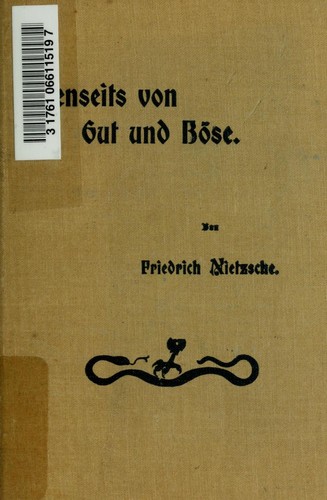
Publisher edition artwork
Beyond Good and Evil
Friedrich Nietzsche · First published 1886
Nietzsche’s potent critique of morality, society, and the human condition remains as provocative today as it was upon its publication
Essential
Demanding · Approximately 250-300 pages, but requires considerable intellectual effort per page.
Why Read It?
To grapple with one of the most influential and controversial philosophical texts of the modern era, challenging ingrained assumptions about morality, truth, and human nature.
What It's About
A penetrating critique of conventional morality and philosophy, arguing for a re-evaluation of values and the emergence of a 'free spirit' who transcends herd instincts and traditional dualities.
Why It Matters
It fundamentally reshaped philosophical discourse, influenced countless subsequent thinkers, and continues to provoke critical reflection on the origins and consequences of our moral and cultural beliefs.
The Review
Friedrich Nietzsche’s *Beyond Good and Evil*, first published in 1886, is not merely a philosophical treatise; it is an intellectual gauntlet thrown down at the feet of Western thought. Penned in a period of intense creative output, following his break with Wagner and the initial stirrings of his final, tragic descent into mental illness, the work sees Nietzsche at his most incisive and provocative. Here, he scrutinises the very foundations of morality, exposing what he perceives as the herd instincts and prejudices underpinning traditional ethical systems. He challenges the reader to move beyond conventional notions of good and evil, advocating instead for a re-evaluation of all values and the cultivation of a higher type of individual, one who embraces strength, self-overcoming, and an aristocratic sensibility of the spirit. The book is structured as a series of aphorisms and essays, making it deceptively accessible yet demanding in its intellectual weight.
Nietzsche’s prose, even in translation, possesses a captivating vigour, a blend of poetic flourish and razor-sharp argumentation. He targets the prevailing philosophical currents of his time – particularly English utilitarianism and German idealism – with relentless wit and often biting sarcasm, all whilst sketching out his own vision for a more authentic and life-affirming philosophy. *Beyond Good and Evil* serves as a crucial prelude to *On the Genealogy of Morality* (1887), offering a comprehensive overview of his mature thought on ethics, psychology, and the will to power. It is a work that demands careful consideration, its arguments often misunderstood or wilfully distorted, yet its capacity to provoke introspection and intellectual discomfort is precisely what ensures its enduring relevance. To engage with Nietzsche is to embark on a challenging but profoundly rewarding journey into the depths of human motivation and belief, a journey that few other thinkers can so forcefully compel.
Best Read
In a quiet study, preferably with a strong black coffee, allowing ample time for reflection and re-reading.
Three Things You'll Take From It
- 01
Morality is not universal but historically constructed and often rooted in unconscious prejudices.
- 02
The concept of 'good' has been inverted by slave morality, valuing weakness and pity over strength and nobility.
- 03
Genuine philosophical inquiry requires questioning fundamental assumptions and moving 'beyond good and evil'.
Better Read or Heard?
While the aphoristic style might lend itself to audio, the density and complexity of Nietzsche's arguments often demand visual access to the text for re-reading and cross-referencing. A skilled narrator, such as Simon Vance, might make it approachable.
If You Like This…
Thus Spoke Zarathustra — Friedrich Nietzsche
A poetic and more directly literary exposition of many themes in *Beyond Good and Evil*.
Find it on AmazonOn the Genealogy of Morality — Friedrich Nietzsche
A deeper, more historical exploration of the origins of moral concepts, complementing the arguments in *Beyond Good and Evil*.
Find it on Amazon
The Edition to Own
The Penguin Classics edition (ISBN: 978-0140449447), translated by R.J. Hollingdale, is a widely respected and accessible version, available in paperback. Walter Kaufmann's translation (Vintage Books) is also highly regarded for its precision and comprehensive notes.
As an Amazon Associate I earn from qualifying purchases. Links cost you nothing and never influence what we recommend.